Hike for Life
How to Train at 50+
We surveyed 58 of our members between 50 and 80. Here are our key findings for keeping moving in the mountains.
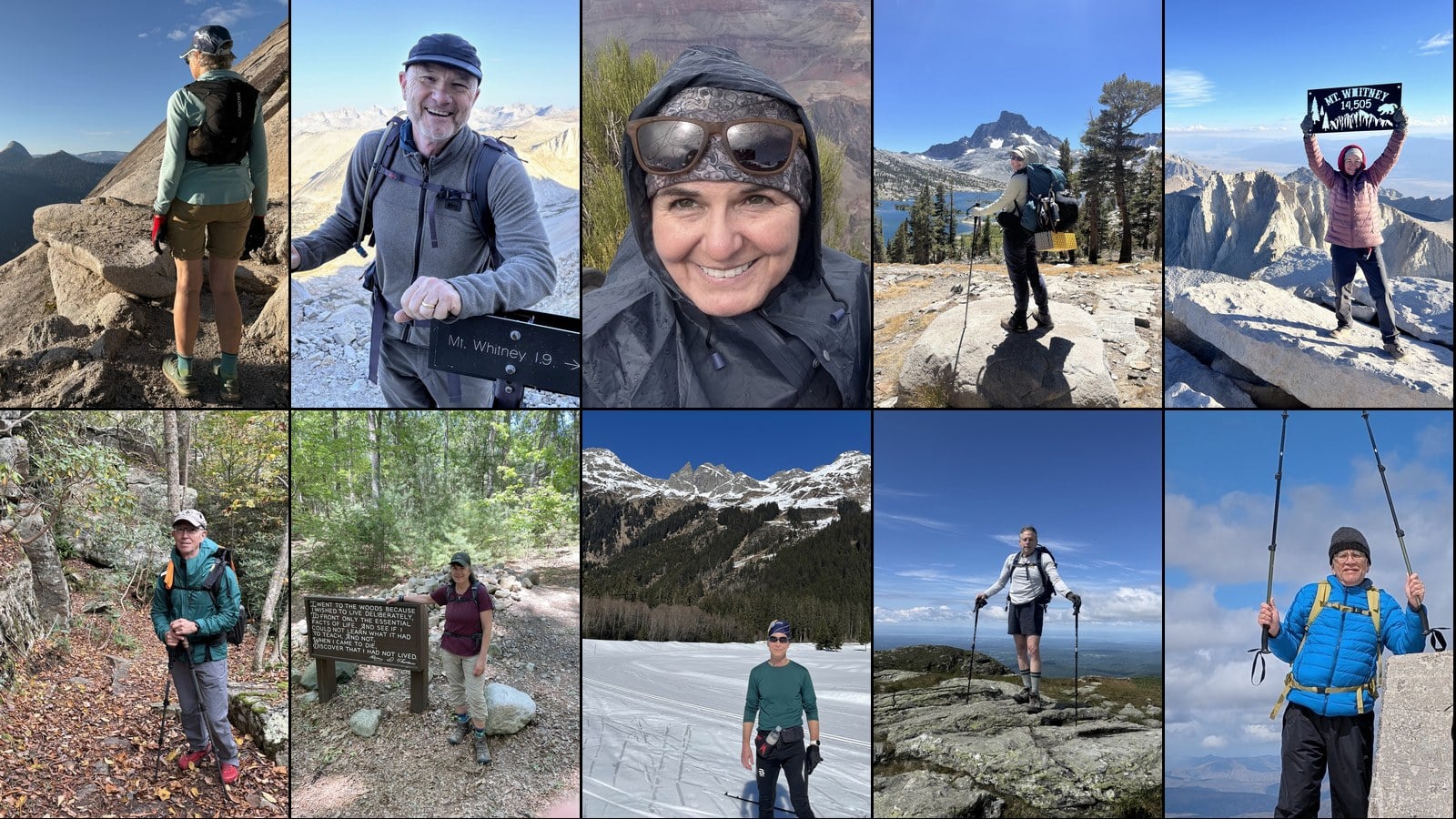
If the trails feel harder than they used to, if recovery is taking longer than it did ten years ago, if you are a little more careful on the big descents now, you are not imagining it and you are not alone.
I am 33. I do not have the lived experience of training past 50 and I am not going to pretend I do. When I started Outdoor Adventure Training I thought I would be working with elite mountain athletes pushing the boundaries of what is possible. That shifted fast. Our client base got older, and more of them are 50-plus every year. They are also the most inspiring people I work with. Seventy-year-olds training for big treks. Sixty-year-olds signing up for objectives they have never attempted. They are not accepting the labels handed to them.
So I went and got equipped. I have been a certified personal trainer for 13 years, and this year I earned my Senior Fitness Specialist certification through the National Academy of Sports Medicine. I will be honest, I do not love the name, and neither do our members. This is not senior fitness. This is about aging functionally so you can keep doing the things you love.
And rather than guess what our athletes over 50 needed from us, we asked them. Fifty-eight responses, ages 50 to 80, 32 women and 26 men, across eleven different programs. Some of what came back genuinely surprised me.
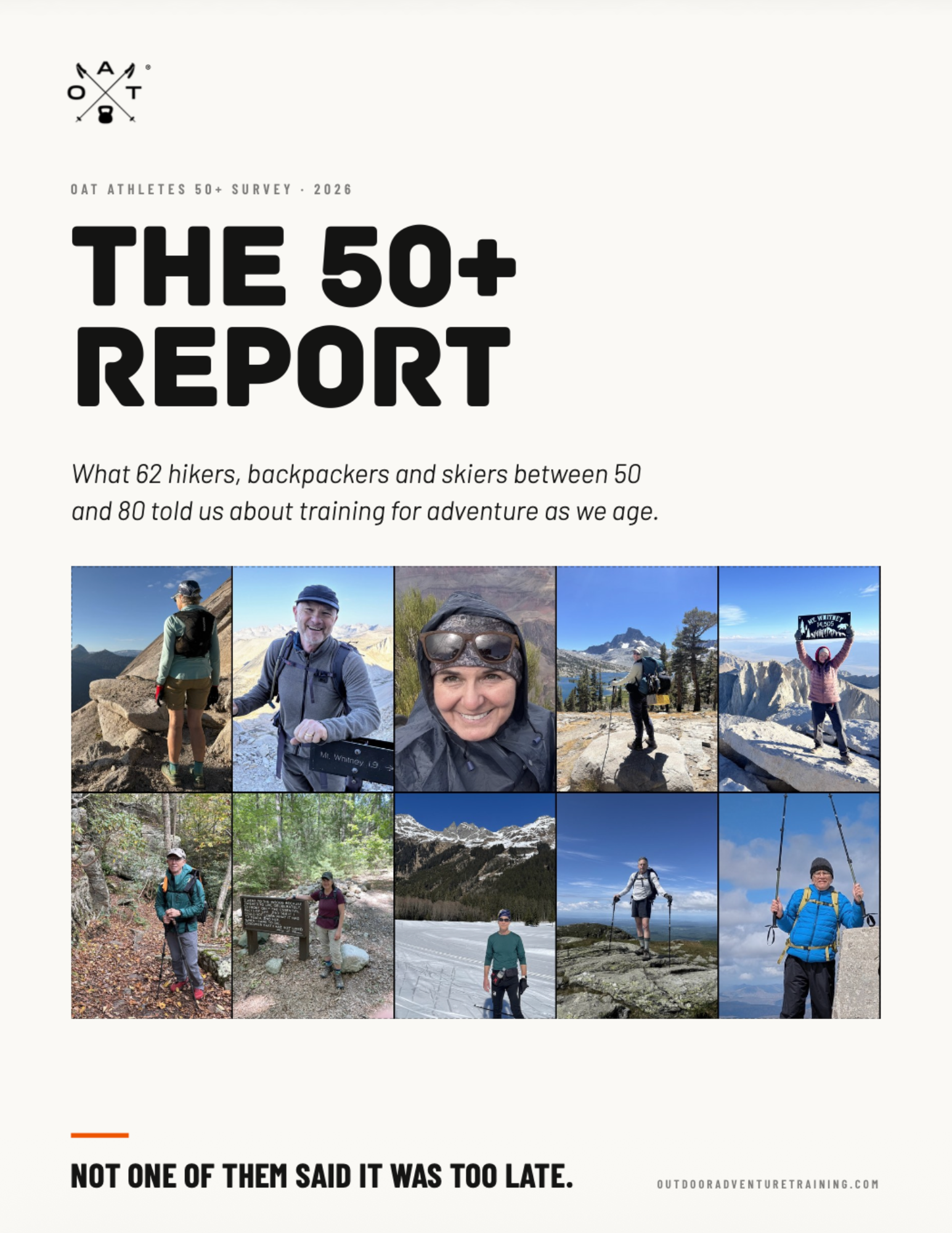
Get the Full Report
Eleven pages. Every answer ranked, split by decade and by gender, plus what our members can do now that they could not do before. Printer-friendly.
The Survey: What They Told Us
We asked two separate questions. First, how much have these physical changes affected your training. Second, how much have these gotten in the way. Here is everything, in order, with nothing left out.
OAT Athletes 50+ Survey
Physical changes affecting training
Percentage answering “somewhat” or “a lot.” OAT Athletes 50+ Survey, 58 respondents, 2026.
OAT Athletes 50+ Survey
What gets in the way
Percentage answering “somewhat” or “a lot.” OAT Athletes 50+ Survey, 58 respondents, 2026.
Two things jumped out
Mobility finished first and balance finished dead last. Hold onto that second one, because I think it is the most important number in the whole survey, and I think our members are wrong about it.
Then there is the second list. The biggest barrier was not fear of getting hurt, which came in at 40%. It was not feeling too old either, which was near the bottom at 31%. The single biggest thing getting in the way of training after 50 was comparing yourself to what you used to do. Fifty-nine percent.
That is the thread running through everything below. Five pillars: muscle, balance, mobility, aerobic endurance, and reactive strength. We will take them in order.
Pillar One: Muscle
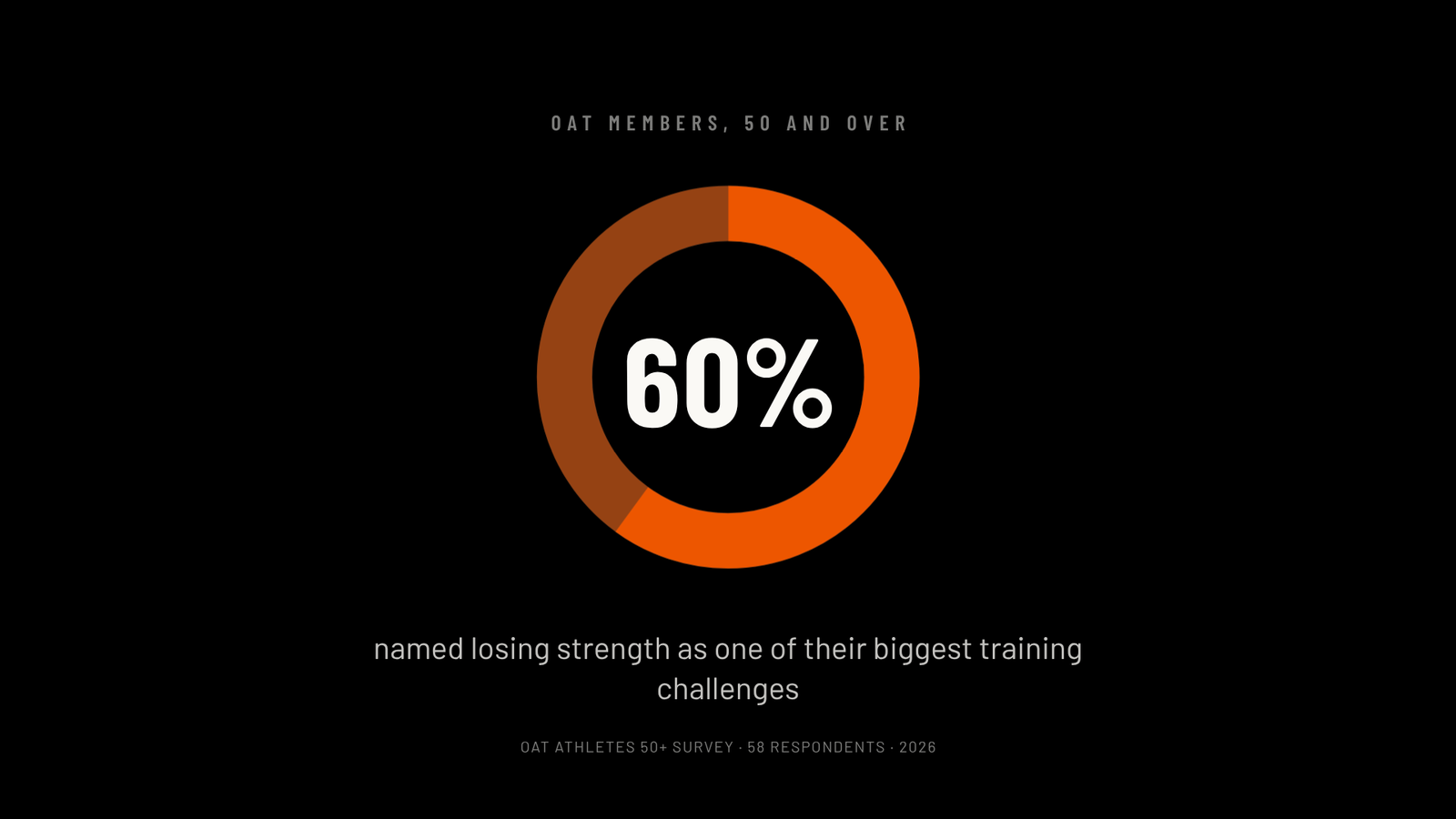
Muscle is the currency. It is the one you do not notice losing until it costs you something. Sixty percent of our members named losing strength as a challenge. My honest guess is the real figure is closer to a hundred, because most people do not clock it until something that used to be effortless suddenly is not.
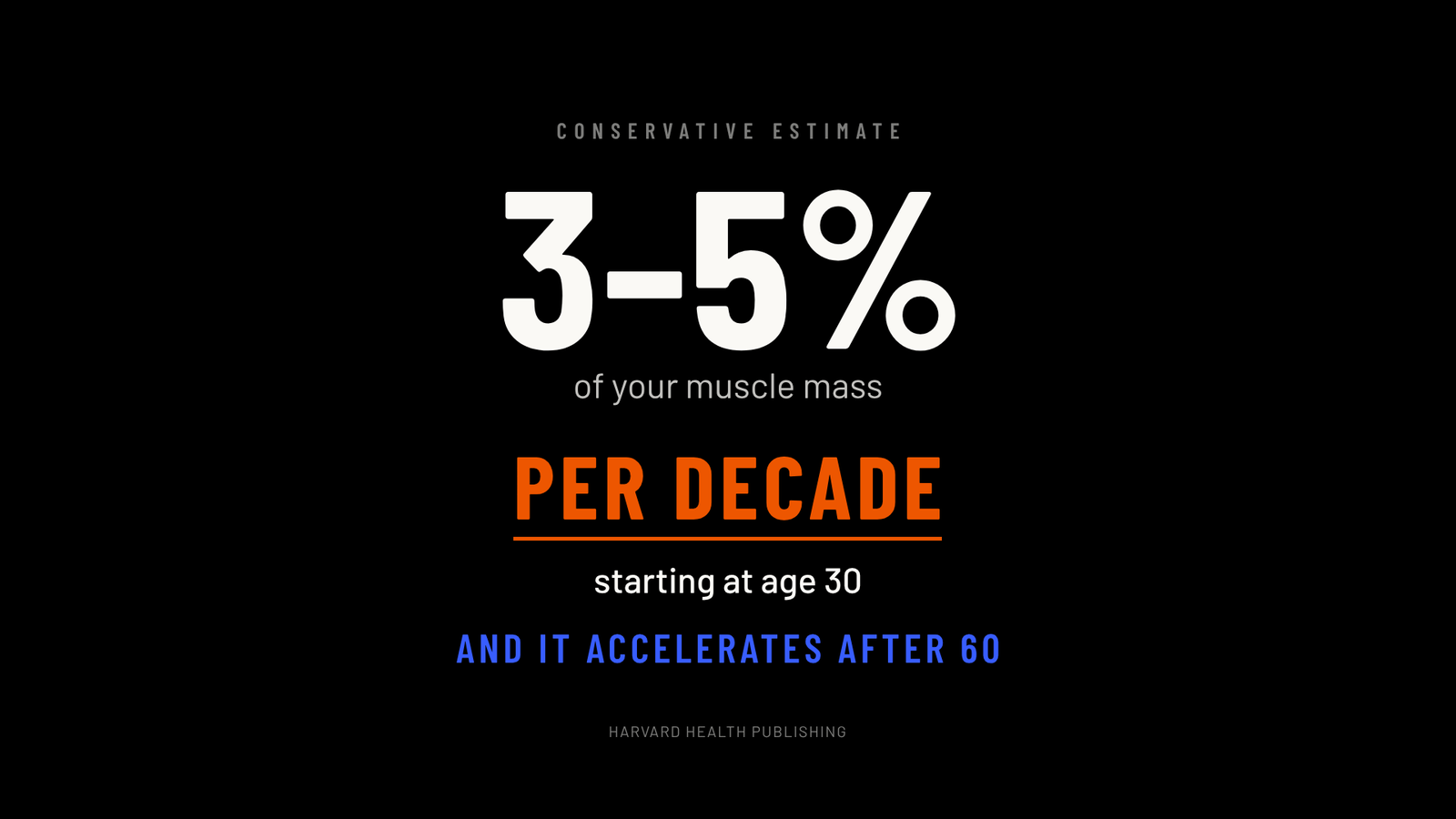
On the conservative end you can expect to lose 3 to 5% of your muscle mass per decade once you pass 30, and that accelerates after 60. But the part that matters is this: the people who lose the most are the people who are not training. This is a dose response, not a clock.
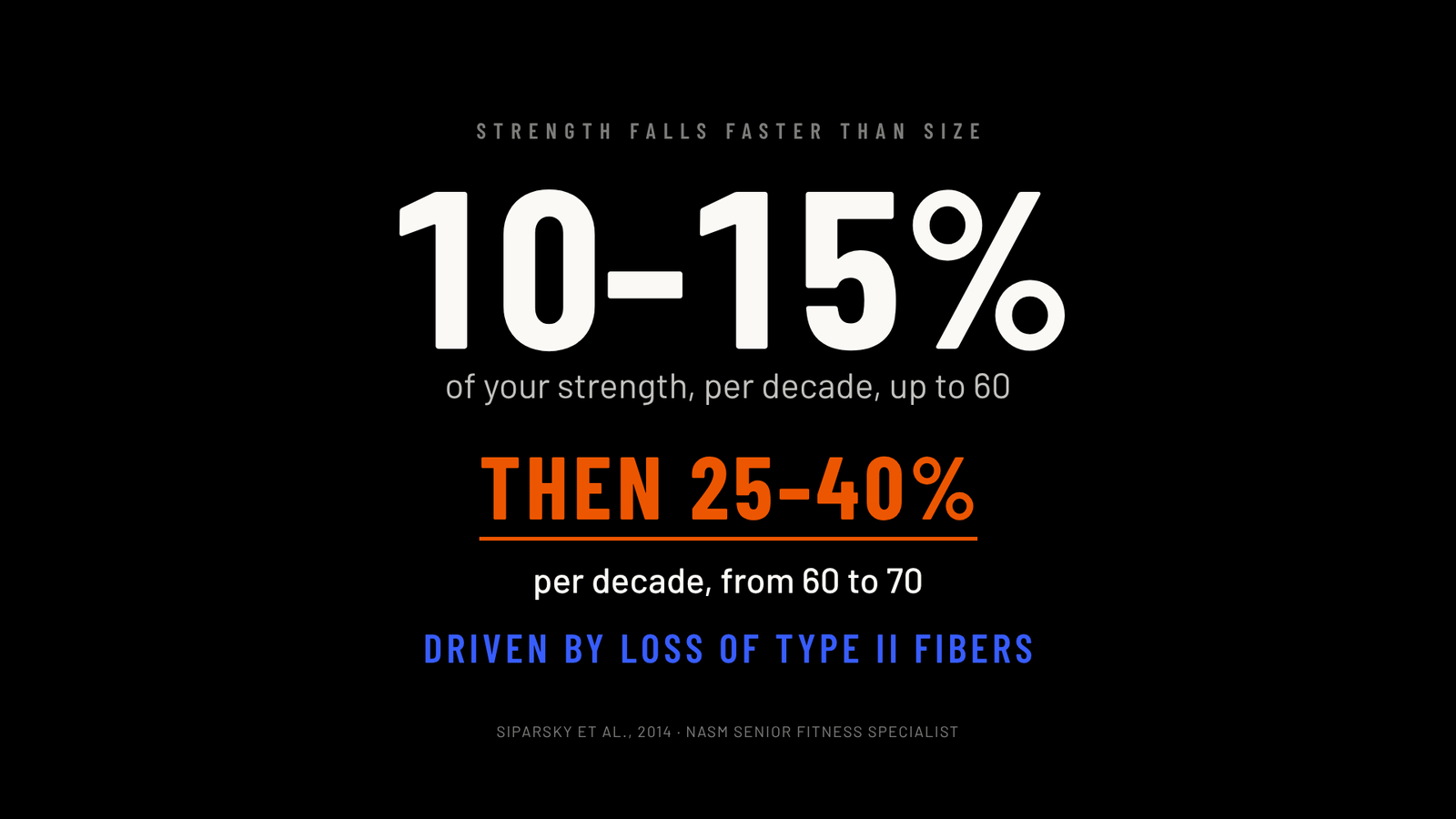
And there is something worse hiding underneath that number. Strength declines faster than mass does. You can look about the same at 65 as you did at 55 and be measurably weaker, because the type II fibres that produce force go first.
“I just want to maintain what I’ve got”
I hear this constantly, and I understand it. But if maintenance is the goal, you are declining. You have to be pushing, adding load, reaching for the heavier dumbbell. We are creatures of habit and it is easy to grab the same 15s every single session.
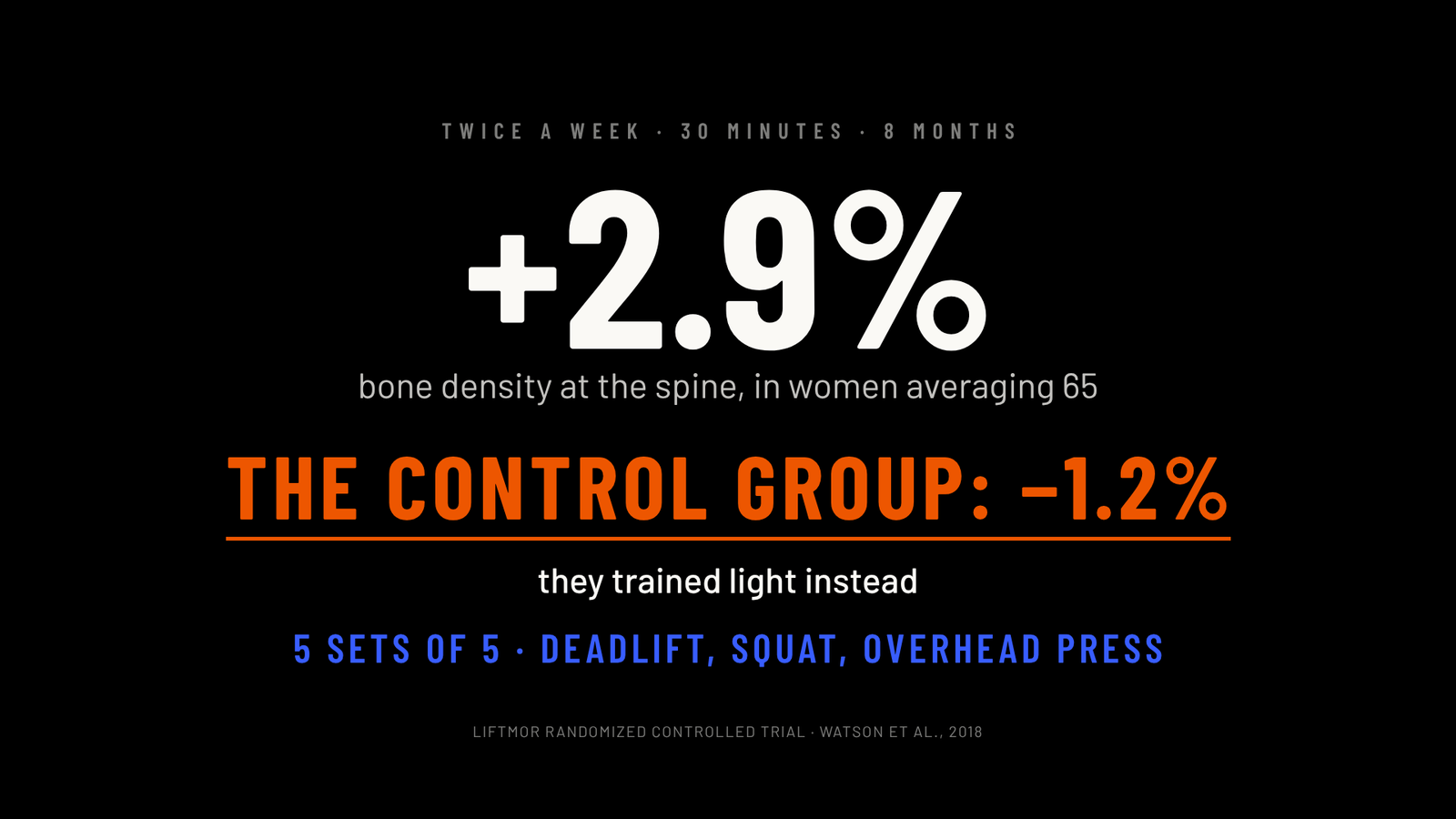
This is not only about muscle either. Heavy compound work, squats and deadlifts and loaded carries, is some of the best evidence we have for holding onto bone density and tendon health as we age. The LIFTMOR trial is the one worth knowing about.
One of our athletes, 60, described what that actually feels like on the trail.

Michelle
56 · Backpacker’s Bootcamp
I feel stronger overall, especially when it comes to my balance and single-leg strength.
Where it shows up: My performance on trails compared to some of my peers is better. Crossing streams, getting up and down steep inclines.
Pillar Two: Balance
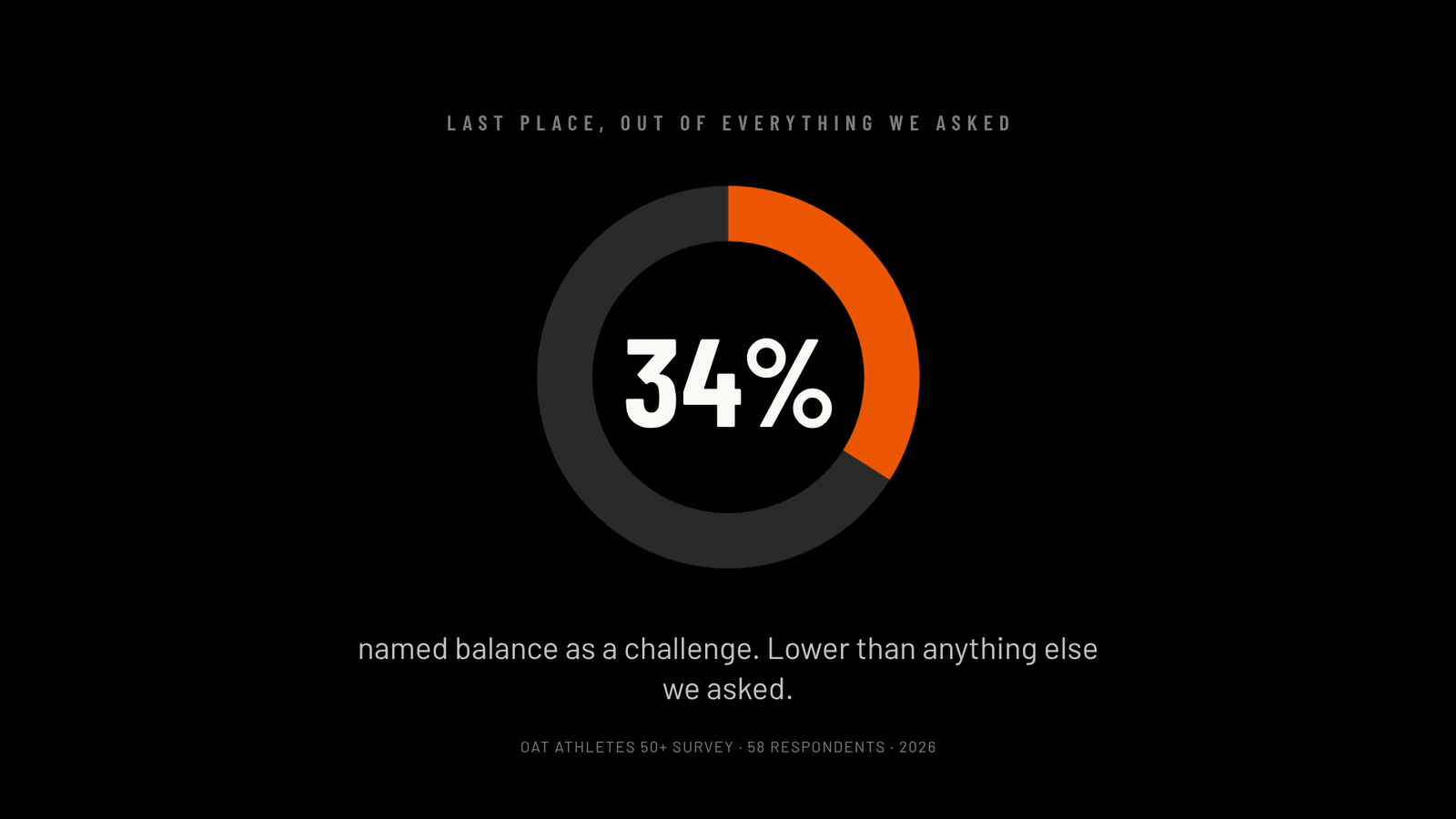
Thirty-four percent. Lower than anything else we asked about. I think our members are wrong about this, but not for the reason you would expect.
Balance holds up reasonably well until around the sixth decade of life, and then it starts to decline relatively quickly. So they are not wrong that it is not a problem yet. They are wrong about when to start working on it.
I will also say our data is probably skewed here. If you are in one of our programs you have been doing balance work for months without necessarily calling it that.
The study that changed how I think about this
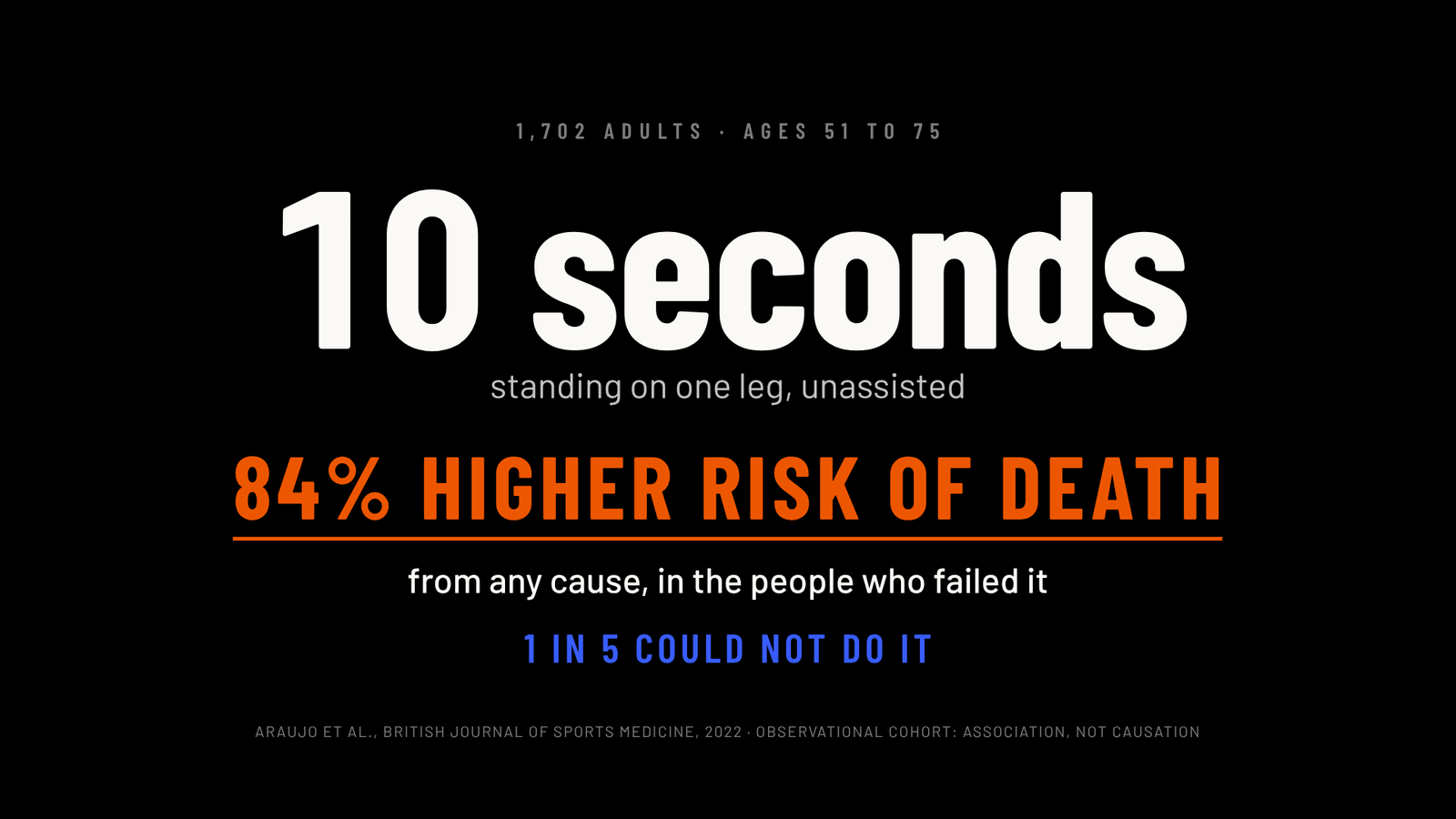
In 2022, researchers followed 1,702 adults aged 51 to 75. The people who could not hold a 10-second single-leg stance had close to double the risk of dying from any cause over the following years. About one in five could not do it.
Three different jobs
What actually keeps you upright
Most training programs only ever cover the first one.
Why this matters more than the rest of it
The biggest hazard as we age is a fall. One in four adults over 65 falls every year. It is the leading cause of injury-related death in that age group, and falling once roughly doubles your chances of falling again. For anybody reading this, a fall is also weeks or months away from training.
How the spiral starts
One fall, and the cost compounds
This is why we treat balance as a training priority rather than a nice-to-have.
Standing on one leg while you brush your teeth is not balance training
It is a great habit. It is not progression. Balance responds to overload exactly the way strength does. You have to challenge your proprioception in a controlled environment and then make it harder over time, by changing the surface under you, by taking away your vision, by adding head movement. It is also not just your legs. A large part of balance is your core and your ability to control your trunk over one foot.
And being cautious on a descent is fine. We recommend it. What we do not want is being unstable and calling it cautious.

Joy
67 · Trek Prep
Joy rated every single physical challenge on our survey as “not much.” Then she told us what had changed since she started training.
I have been able to manage trips and slips without falling down. Success!
She did not name balance as a problem because her training had already handled it.
Balance Is Trainable
Surface, vision, head movement, progressed week over week, built into the same plan as your strength work. Not a drill you remember to do at the sink.
See Trek Prep Built For Real Mountain DaysPillar Three: Mobility
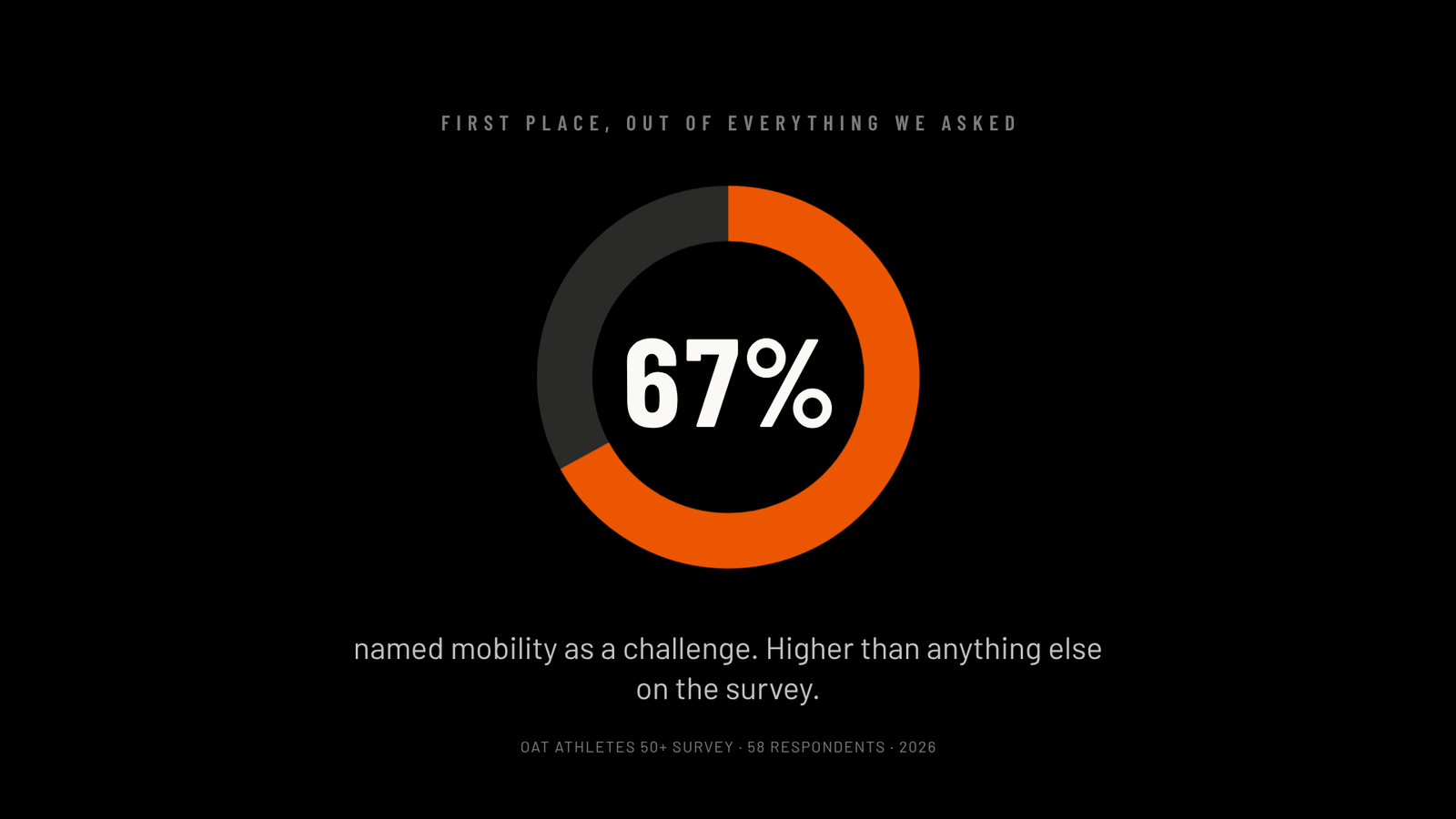
Sixty-seven percent, higher than anything else we asked. I do not think I need to convince anybody reading this that they have gotten stiffer.
What happens is that your tissues get stiffer and less supple and your usable joint range shrinks. That feeds straight back into the two pillars above. If you cannot access the range, you cannot express the strength. If you cannot access the range, you cannot catch yourself when you stumble.
Why mobility sits underneath everything
Each step down makes the next one easier
Flexibility and mobility are not the same thing
Flexibility is tissue length, how long the tissue is. Mobility is control through a range, owning that range. Flexibility plus control equals mobility. Range without control is not durability, it is a party trick.
A couple of stretches a day is not going to move the needle. This has to be a daily habit, aimed at the structures that are actually tight on you. We bake myofascial work, foam rolling and trigger point release, plus active and dynamic stretching into essentially every workout we write. You cannot get through one of our programs without it.
The good news is that this is the pillar that pays off fastest. Strength takes months. You will feel mobility changes in weeks if you are consistent, and that matters, because feeling something work is what keeps people going. One of our members, 80 years old, put it simply: Flexibility and mobility are improving. I didn’t realize how stiff I had become.

Deanna
50 · Backpacker’s Bootcamp · 20-year endurance athlete
I would never do this type of programming on my own. Having it in the plan and being a person that has to check that box complete, it gets done. I can definitely tell it’s helping with functional movement and recovery.
Deanna has coached endurance athletes for 15 years. The mobility work is still the part she would skip if it were not written down.
The One That Surprised Me
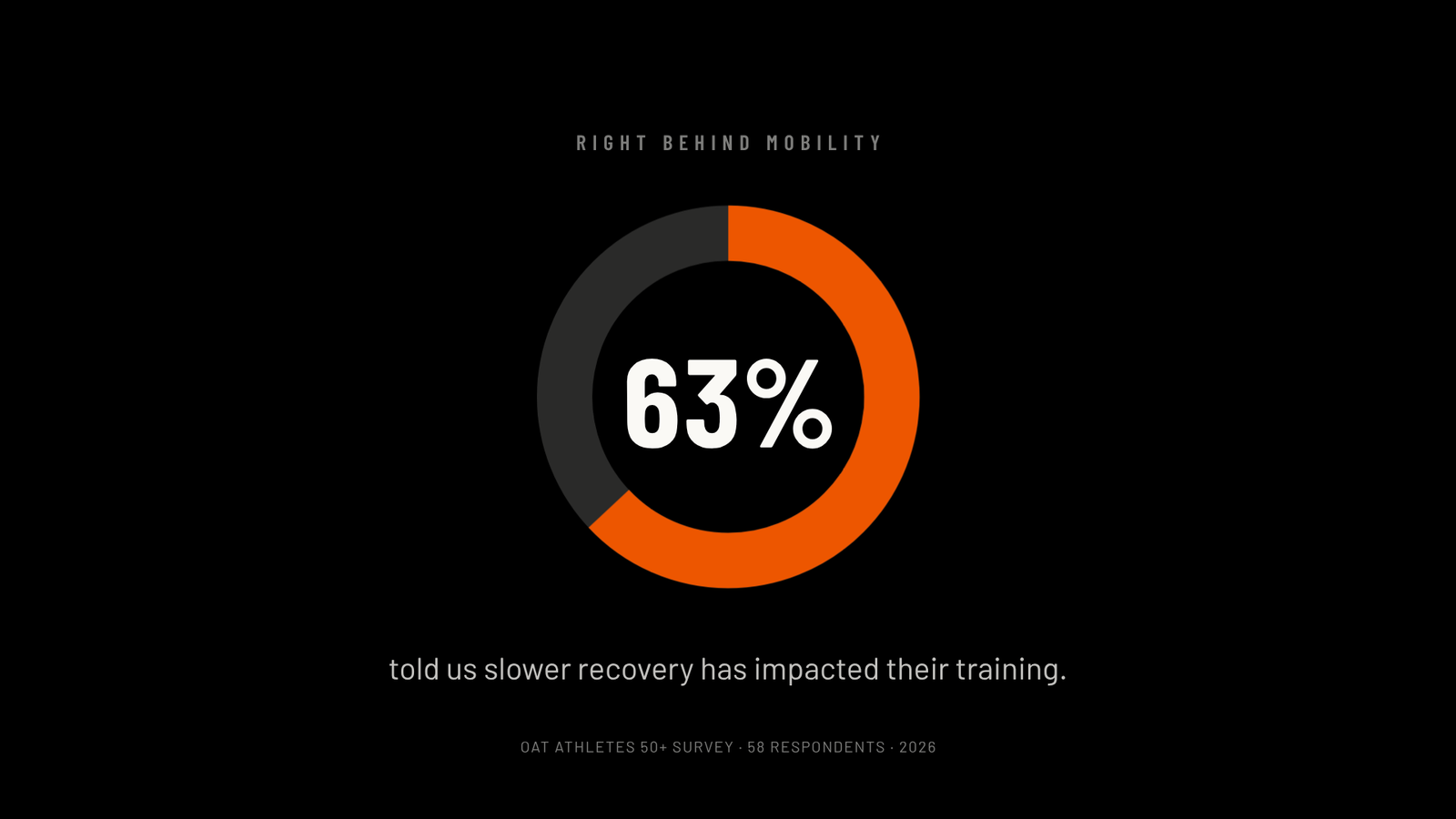
Sixty-three percent said slower recovery is affecting their training, which was higher than losing strength. Mobility work is part of the answer. So is eating enough.
As we age we tend to move a little less, appetite can drop, and a lot of people end up under-eating both total calories and protein without realising it. Nothing in that chain feels dramatic on any single day.
The quiet version
How under-fuelling creeps in
That is a whole article on its own, and we will write it.

Steve
77 · Trek Prep
Speedier recovery and better sleep due to rolling and stretching. HUGE.
He is also honest about what has not moved yet: I’m not making as much improvement in endurance. Did a day hike on the AT with a 30 pound pack and I was huffing and puffing on long, steep upgrades.
Pillar Four: Aerobic Endurance
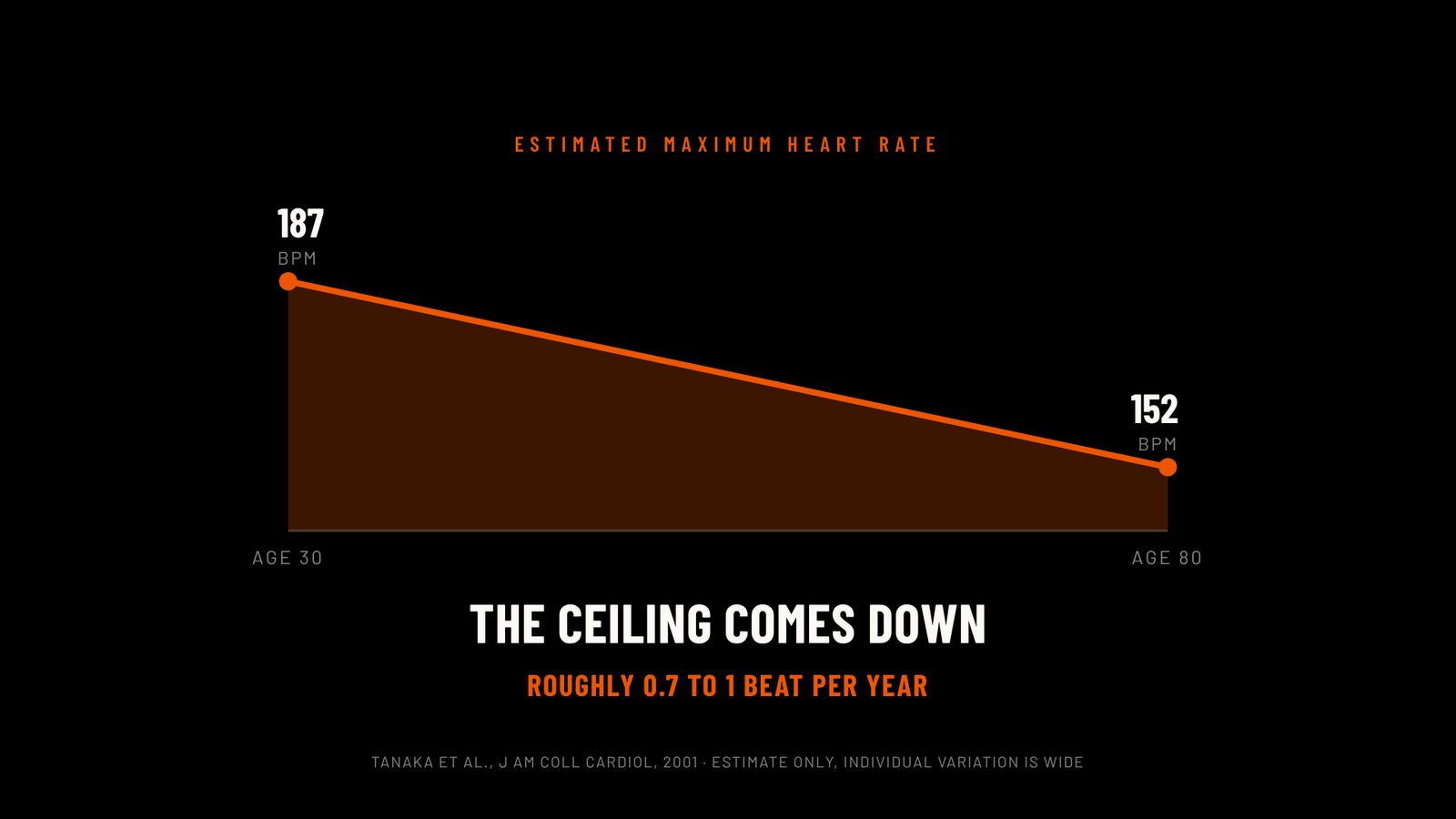
Your maximum heart rate declines as you age, roughly 0.7 to 1 beat per year, and there is nothing you can do to stop it. The ceiling comes down whether you train or not.
What you can change is everything underneath that ceiling. We use a five-zone model, and zone 2 is the sweet spot for longevity: slow, steady, conversational aerobic work. Walking, hiking, cycling if you want it lower impact. That is what lets you go all day on the trail.
Reference
The five heart rate zones
Percentages of maximum heart rate. If you can talk in full sentences but you are slightly winded, you are in zone 2.
Your race at your pace
I see this constantly with older athletes. They get out with a younger group, spend the day in zone 4, burn out early, and pay for it for two days afterward. Find your zone 2 ceiling and hold yourself to it. It is fine to go above it sometimes, as long as you have a plan for fuelling and recovery on the other side.

Eric
65 · Trek Prep · two years in
Endurance on the trail. I can go harder, longer and higher without being winded. Much fewer rest stops.
What he is training for: Get back to high altitude climbing and hiking.
Pillar Five: Reactive Strength
Plyometrics. I know it sounds like the least appropriate thing on this list. It is not about hopping around. It is about controlled landings, deceleration, and being able to step down quickly and absorb force.
Downhill hiking and going down stairs are reactive skills. If you never train them, they are the first thing to go, and they are the exact capacity that catches you when a foot lands wrong.
Start here
Three cues for the landing
Step down off a low box, land, hold. That is the whole first session.
The research here comes with a caveat worth reading carefully. A 2025 systematic review found 74% fewer falls when reactive work was added to an existing exercise program, and no significant effect from reactive training on its own. It is the adding that does the work, on top of the strength and balance that are already there. This is the fifth pillar for a reason. It sits on top of the other four.

Mark
68 · Alpine Touring · two years in
My back used to inform me that landing from height was no longer a good idea. The core and posture work and the hops, steps and lunges have given me the ability to land without hurting myself.
Asked what he would tell someone who thinks it is too late: I had shoulder, back and knee pain from injuries for years and it is gone.
And when we asked James, 62, what he can do now that he could not do before, he answered in one word. Jump.
It Is Never Too Late
There is a study from 1990 that I come back to constantly. Researchers took ten frail nursing home residents, average age 90, and put them through eight weeks of resistance training.
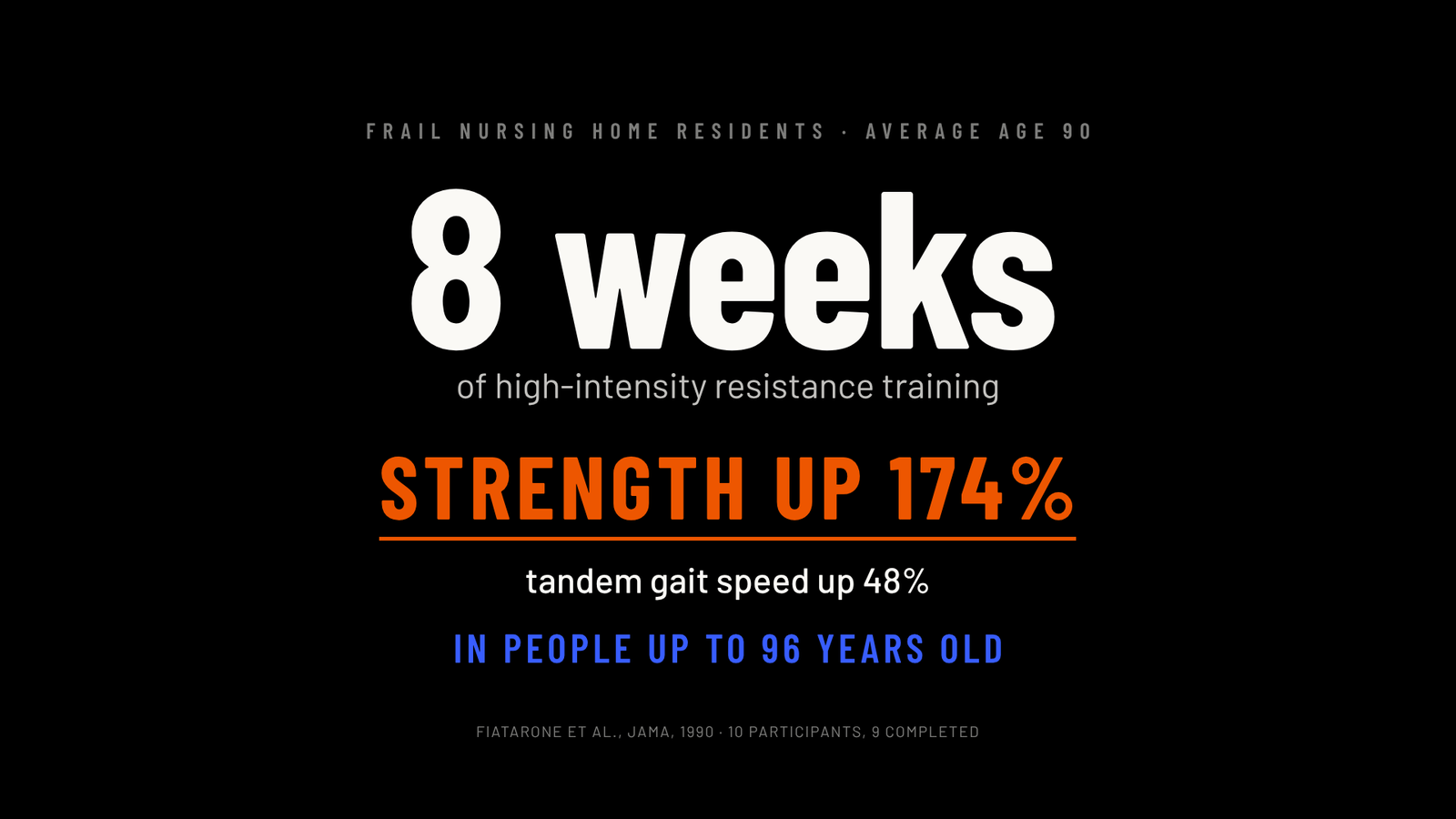
It would never pass for proof on its own. But the direction of it has held up in the 35 years since, and the number that stays with me is the gait speed, because walking speed is the thing that decides whether you stay independent.
The second thing came out of our own survey. We asked all 58 members what they would tell someone their age who thinks it is too late to start. Every single person answered.
58 answered · not one said it was too late
In their words
If it’s late today, it’s later tomorrow.Eric, 65
Feeling that it’s too late to start is the reason to start.Richard, 59
NEVER!! Use it or lose it. Not declining further IS progress.Paige, 64
Just start. A little is better than nothing. You’ll thank yourself for it.Colleen, 67
You have nothing to lose and a lot to gain.Pankaj, 68
Trust the process. The programs are designed to meet you where you are.Patrick, 70
It’s not. Start gradually and stay consistent.Steve, 77
Nope. More important than ever now.Mark, 65
Be patient. Increase load and volume slowly so as not to injure yourself.Ken, 71
Enjoy the level at which you can perform. Keep it fun.James, 62
Never too late to start. For me it’s more about not stopping, and balancing rest and nutrition.Michelle, 56
It’s not too late if you put your trust, and effort, into the process.Steve, 53
Don’t be afraid to modify. Maybe as your body gets stronger, you will be able to do it in the future.Brenda, 60
It’s not too late!! Just start today and build slowly.Drue, 67
The exercises are adaptable for any fitness level. It’s never too late! Start tomorrow!Joy, 67
It’s never too late with the proper training and nutrition.Deanna, 50
A selection of the 51 members who consented to be quoted. Shared with permission.
Two of them in particular

Patrick
70 · Trek Prep · three months in
I was thinking maybe it was just time for me to hang up my hiking boots.
Three months later: The program and its welcoming structure have made me feel confident that I can reach my goals.

Brenda
60 · Trek Prep
Can do half pushup from toes, something I was never able to do. Way back in gym class, girls were always told to do them on their knees, so it was never in my head that it was something I could strive for.
On what made the difference: Motivating me to do things I thought I was no longer capable of.
And one more
Drue, 67, was coming down the Four Mile Trail in Yosemite with a heavy pack when she fell on a downhill switchback. One of her sons caught her. What stayed with her was not the fall.

She went home and started looking for a program.
Quick Reference
The five pillars, in order
- Muscle. Heavy compound work. If nothing is going up, you are declining.
- Balance. Progressed by surface, vision and head movement, not by repetition at the sink.
- Mobility. Daily, aimed at what is actually tight on you. Pays off fastest.
- Aerobic endurance. Zone 2 is the base. 150 minutes a week is the floor.
- Reactive strength. Controlled landings. Added on top of the other four, never instead of them.
What our members got wrong
- Balance finished last, and it is the one that decides whether a stumble becomes a fall.
- Fear of injury was not the main barrier. Comparing yourself to your younger self was.
- If maintenance is the goal, you are declining. You have to be pushing, adding load.
Common Questions
Is it too late to start strength training after 50?
No, and the evidence on this is unusually strong. The 1990 Fiatarone study put nursing home residents averaging 90 years old through eight weeks of resistance training and saw strength rise 174% and gait speed improve 48%. If that population responds, so will you. Of the 58 OAT members we surveyed, not one said it was too late.
How much muscle do you lose as you age?
Conservative estimates put it at 3 to 5% of muscle mass per decade after 30, accelerating after 60. Strength declines faster than mass does, roughly 10 to 15% per decade to age 60 and then 25 to 40% per decade to 70. The people who lose the most are the people who are not training, so the rate is far more responsive to what you do than most people assume.
What is the best balance exercise for hikers over 60?
There is not one. Balance improves the way strength does, through progressive overload across three variables: the surface under you, your vision, and movement of your head. A single-leg stand on firm ground with eyes open is a starting point, not a program. Make one variable harder at a time, and train your trunk and core as well as your legs.
What is zone 2 training and why does it matter after 50?
Zone 2 is roughly 60 to 70% of your maximum heart rate, the pace where you are slightly winded but can still talk in full sentences. It builds the aerobic base that lets you go all day on the trail. It matters more after 50 because your maximum heart rate falls by roughly 0.7 to 1 beat per year, so training at sensible intensities protects your recovery instead of spending it.
Should older hikers do plyometrics?
Yes, in the form of controlled landings rather than jumping for height. Going downhill and down stairs are reactive skills, and they are the first thing to go if never trained. The research is clear that reactive work does its job when added to an existing strength and balance program, not on its own.
What is the difference between flexibility and mobility?
Flexibility is how long a tissue is. Mobility is your control through that range. You can be flexible and still lack mobility, and range you cannot control does not protect you on the trail. Mobility was the single biggest physical challenge our members reported, at 67%.
Watch The Full Breakdown
All of the above, plus the member stories, over on the OAT channel.
Train With OAT
Everything above is in a specific order for a reason. Stability before strength, strength before power, mobility in every session. Doing the right things in the wrong order is how people get hurt, and getting hurt is the thing that starts the spiral.
You do not have to work out that order on your own.
Built For The Terrain You Want To Be In
Science-based training for hikers, backpackers and mountaineers. Strength, balance, mobility and endurance in one plan, progressed week over week, adaptable to where you are starting from.
Start Training Today Twenty-Five Of Our Fifty-Eight Respondents Train HereThis entire article came from our athletes. Fifty-eight of them took the time to tell us the truth about what this is actually like, including the hard parts. Thank you.
See you on the trail.
Sources
- OAT Athletes 50+ Survey, 2026. 58 respondents, ages 50 to 80, 32 women and 26 men. All quotes and photographs used with the respondent’s permission.
- Office on Women’s Health and Harvard Health Publishing on age-related muscle loss.
- Siparsky PN, Kirkendall DT, Garrett WE. Muscle changes in aging. Sports Health, 2014.
- Watson SL, et al. High-intensity resistance and impact training improves bone mineral density and physical function in postmenopausal women with osteopenia and osteoporosis: the LIFTMOR randomized controlled trial. Journal of Bone and Mineral Research, 2018.
- Araujo CG, et al. Successful 10-second one-legged stance performance predicts survival in middle-aged and older individuals. British Journal of Sports Medicine, 2022.
- CDC Older Adult Falls Data.
- Tanaka H, Monahan KD, Seals DR. Age-predicted maximal heart rate revisited. Journal of the American College of Cardiology, 2001.
- Fiatarone MA, et al. High-intensity strength training in nonagenarians. JAMA, 1990.
- World Health Organization Guidelines on Physical Activity and Sedentary Behaviour, 2020.
- Systematic review and meta-analysis of reactive balance training and fall rates, 2025 preprint. Not yet peer reviewed.