Engine vs. Chassis

Stability Before Cardio
Build control before you build volume.
Zone 2 cardio has become a ubiquitous term in recent years.
If you spend any time listening to podcasts, watching YouTube videos, or reading books in the health and longevity world, you’ve heard the prescription: three to four hours a week, conversational pace, build your aerobic base.
And to be clear, it works. It is necessary if you are training for outdoor pursuits.
Zone 2 improves endurance. It supports heart health. It’s sustainable and repeatable. For many people, it’s the first time cardio feels manageable instead of demoralizing and punishing.
But here’s the question no one is asking:
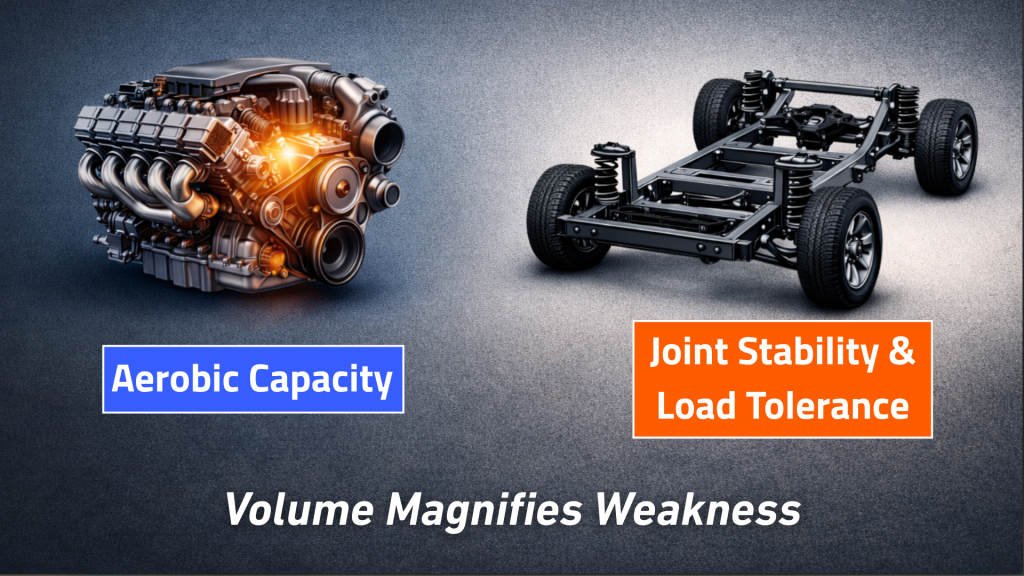
What happens when you layer hours of aerobic work on top of a body that hasn’t built basic strength or stability? What happens when you build a strong engine on a weak chassis?
Rarely have I seen someone on their hands and knees, crawling up a mountain so out of breath they simply couldn’t take another step. Even moderately trained individuals, with the right pacing and fueling, usually manage the uphill just fine.
The breakdown happens when repetition amplifies.
It’s the long descents on fatigued legs.
It’s the quads quivering at mile nine.
It’s the knee that no longer feels stable.
It’s the stabbing heel pain the next morning.
Volume magnifies weakness
The Engine vs The Chassis
The engine and chassis metaphor is simple and accurate. Cardio builds the engine. It improves output, efficiency, and fuel economy. You can go farther without redlining.
But the chassis absorbs force. It keeps everything aligned and prevents the system from rattling apart under stress.
In the human body, that chassis is your joints, connective tissue, and stabilizing musculature. It is your ability to decelerate on descents, control a single-leg landing, and carry load without collapsing through your hips and core.
No amount of aerobic capacity will protect your joints.
The Desk to Trail Gap
The problem isn’t whether to do cardio or stability training. It’s the order in which we build them.
We see two common patterns at OAT.
On one end, a working professional who has been largely sedentary for 20 to 30 years signs up for a big objective. They’re motivated and disciplined. They don’t want to just survive the hike. They want to feel strong and confident.
On the other end, someone who has spent most of their life active in the mountains starts noticing that just doing the thing is no longer enough. The knees ache sooner. The descents feel unstable. Recovery takes longer.
Different backgrounds, same issue: repetition without resilience.
When someone moves from mostly sedentary to three or four hours of weekly Zone 2 work, they aren’t just building endurance. They are dramatically increasing load on tissues that haven’t been prepared for it.
Most people train for the climb. But the real test is the descent.
Before we build a bigger engine, we need control and integrity. The ability to absorb force, decelerate under fatigue, and repeat that for hours or days on end.
That’s where stability training takes priority.
Stability Before Load
Stability is what allows you to build cardio, not the other way around.
Before you add hours or chase mileage, your body needs to demonstrate control. If you layer volume on top of dysfunctional movement patterns, you’re not building durability. You’re reinforcing weakness.
For someone who has spent decades sitting behind a desk, this isn’t about motivation. It’s about neuromuscular connection. The ability for the brain to recruit the right muscles at the right time. When the glutes don’t fire efficiently, the knees take the load. When the hips and core lack control, the lower back compensates. Multiplied by thousands of steps, that compensation adds up quickly.
Stability training for hiking doesn’t need to be complicated, but it does need to be specific.
Glute and Hip Control.
Your glutes are primary stabilizers on uneven terrain. If they aren’t doing their job, your knees and ankles are forced to pick up the slack.
Downhill Durability.
Descending is controlled deceleration. It requires eccentric strength, the ability to lower your body under control step after step without collapsing or bracing for impact.
Core Integrity Under Load.
Carrying a pack demands posture and coordination. If your trunk fatigues early, everything below it becomes less efficient and less stable.
This is what building a strong chassis actually looks like.
It’s not flashy. It doesn’t spike your heart rate or leave a pool of sweat on the floor. But it determines whether your training builds resilience or exposes weakness.
Take it slow. Focus on control.
What Descents Reveal
When I’m out on the trail, I watch one thing: knees on the descent.
It’s rarely the knee’s fault. The knee is simply the messenger. What’s happening above and below it tells the story.
If the arch collapses with each step, that’s a lack of ankle control.
If the knee drifts inward, that’s a hip stability issue.
If the pelvis shifts side to side under fatigue, that’s trunk control breaking down.
You don’t need a lab to see it.
Try this. Film yourself barefoot doing controlled step-ups onto a box. Step up and slowly lower down five times. Watch from the front. Do you own the movement, or does your body search for balance?
That’s your chassis under load.
If it struggles with five controlled reps, imagine what happens after 12 miles and 5,000 feet of descent.
None of this means you shouldn’t do cardio. It means you need to be strategic about how you layer it in.
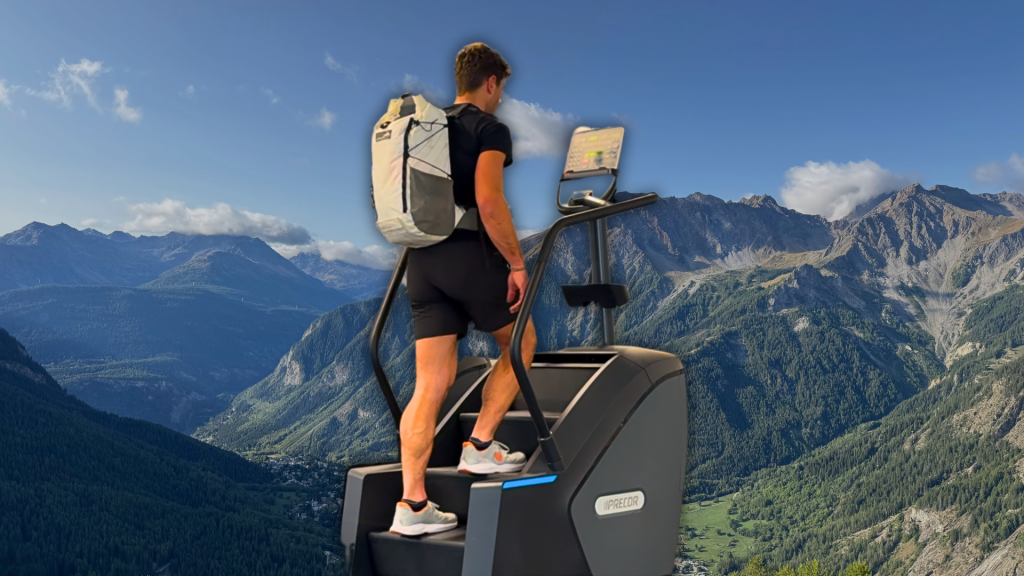
Low-impact modalities like cycling or the elliptical can help you build aerobic capacity safely. But if your goal is hiking, you eventually need sport-specific work. Real steps. Real descents. Real load. That’s where instability shows up.
Build control first. Layer volume slowly. Let your body adapt methodically.
Don’t chase arbitrary weekly hour targets.
Build capacity, then expand it.
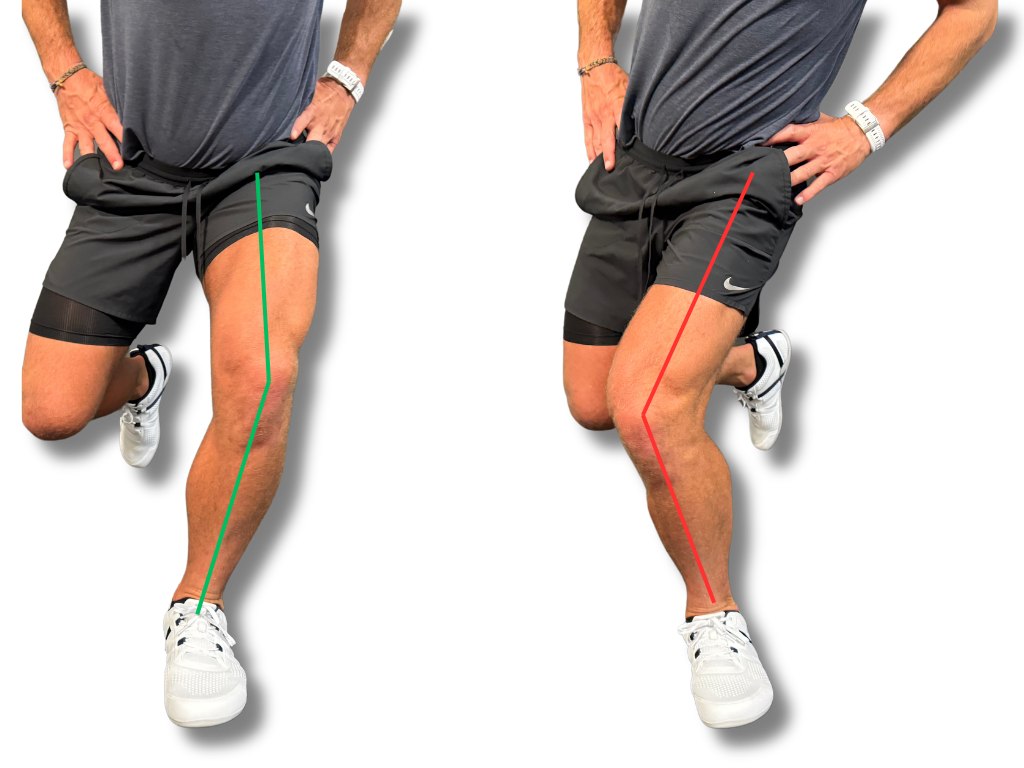
Demonstrating valgus collapse of the knee
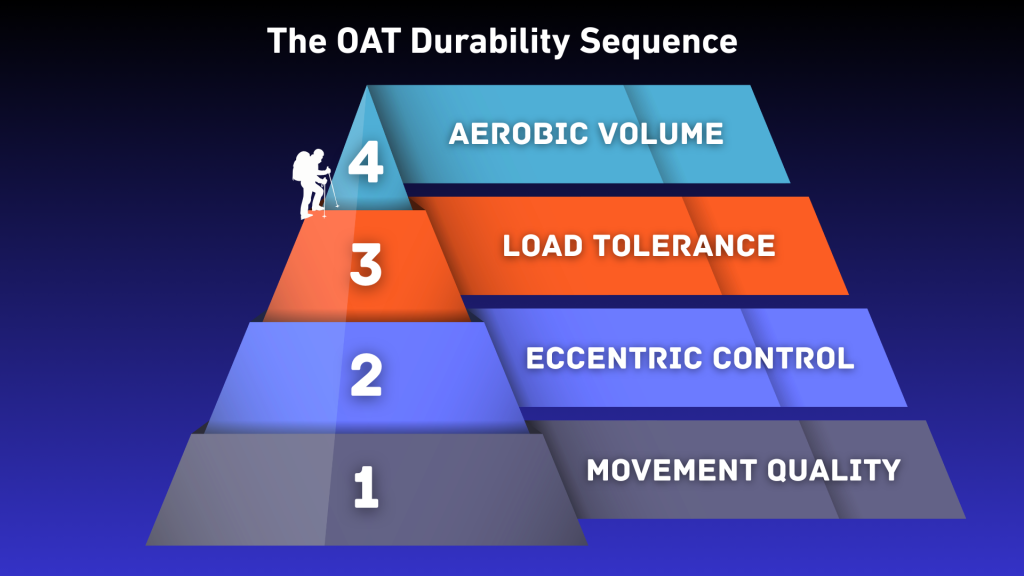
sequence matters
We are not anti-cardio. Cardio is essential if you want to maximize your experiences in the mountains. But without quality movement and control, it often accelerates breakdown instead of progress.
Cardiovascular adaptations take time. Stability takes time too. But improvements in body control, alignment, and strength under load can happen quickly when you train with intention. A small investment now pays off exponentially later.
Focus first on single-leg control and eccentric strength. Learn to lower yourself under control. Own the descent. Build strength that translates directly to uneven terrain and long days under load.
As your mechanics improve, gradually layer in more instability, more load, more fatigue. Expand your capacity in stages.
Then build the engine.
You need aerobic capacity. A well-built chassis keeps that engine useful for decades.
The goal isn’t to survive one big day.
The goal is to still be moving well at 60, 70, and beyond.