Ymir Climber

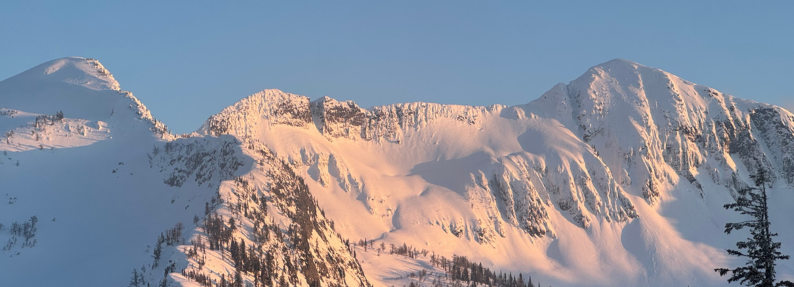
Ymir Climber
A Weekend of Racing in the Kootenays
Every winter, we see athletes and clients struggle to find meaning in their training. Even with a meaningful objective six to eight months out, it can be a challenge to stay disciplined through the cold, dark months. But training should not be conditional. It’s not something we only do once a trip is booked. It’s something embedded in the lifestyle.
For OAT coaches Mikey Bell and Emily Maddox, the goal is simple: stay fit enough, durable enough, and consistent enough to step into an objective when the opportunity presents itself.
This January, the Ymir Climber was one of those opportunities.
In January 2026, we participated in the first two days of the Ymir Climber at Whitewater Ski Resort in Nelson, BC, taking on both the Vertical Race and the Individual Race
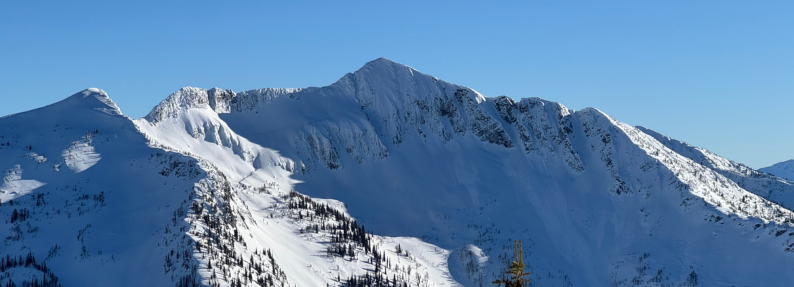
What is The Ymir Climber?
The Ymir Climber is a Canada Cup ski mountaineering event hosted annually at Whitewater Ski Resort beneath Ymir Peak in the Selkirk Mountains.
The weekend features multiple race formats, including a vertical race with a single sustained uphill effort, an individual race with multiple ascents, descents, transitions, and boot packs, and a sprint race featuring frequent transitions and a slalom-style finish.
The event attracts a wide range of athletes, from recreational skiers on traditional touring setups to elite racers competing for national team points. Several members of the Canadian National Ski Mountaineering Team were on the start line this year, making for a deep and competitive field.
Skimo continues to grow globally and will make its Olympic debut in 2026. Events like the Ymir Climber play an important role in developing the sport at both the grassroots and elite levels.
How We Trained
To be clear, neither of us are “racers.” We’re lifelong recreationalists and outdoor professionals, but not athletes who chase podiums or build seasons around events. That said, the right objective at the right time can be a powerful motivator. Signing up for a race is a reliable way to show up when you might otherwise bail, and it’s also an excellent way to engage with the community and connect with like-minded people.
Our training is year-round and intentionally general for most of the season. Strength, aerobic capacity, and durability come first.
When it’s time to prepare for an event like the Ymir Climber, the shift toward race-specific demands is subtle and usually happens four to six weeks out. For us, that meant increasing uphill volume, focusing more on muscular endurance, spending more time in longer sustained efforts on skis, and layering in targeted high-intensity intervals.
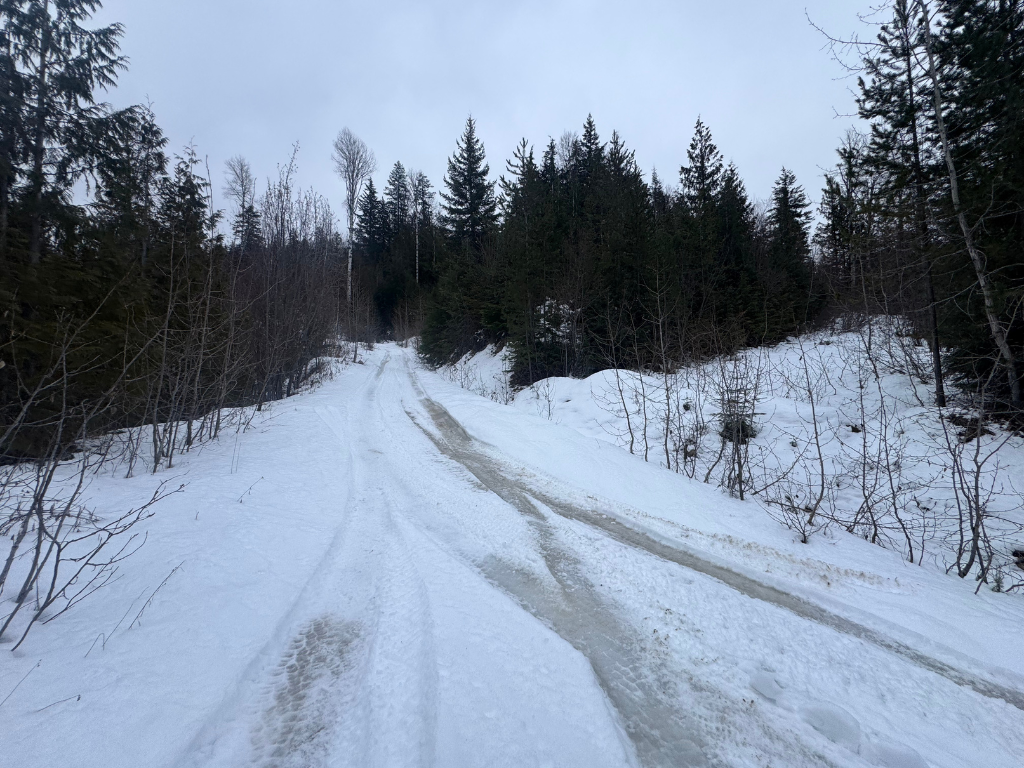
Attempting to get meaningful uphill work in on an icy road
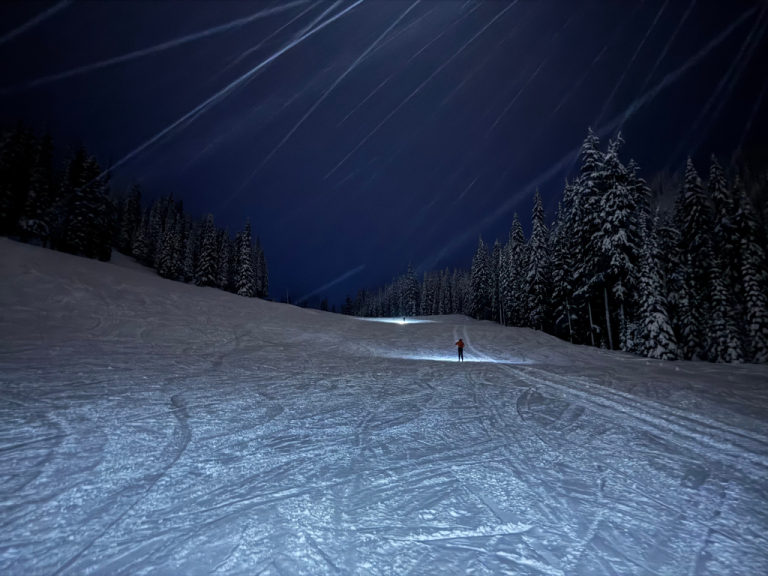
Evening uphill laps during Mini Mucker SkiMo night at WH2O
This season came with a challenge. A rain-on-snow event followed by arctic temperatures locked the snowpack into a massive ice block. Backcountry conditions quickly became dangerous, limiting access to safe uphill terrain. We leaned heavily on groomed nordic trails and established skin tracks that allowed for non-consequential descents.
Most of our quality work came from steady Zone 2 aerobic climbs for efficiency and time on feet, sustained Zone 4 efforts to simulate race pacing, and short, hard intervals to build tolerance for high-output climbing. Heart rate monitors helped guide these efforts and collect useful data when terrain options were limited.
Vertical Race
The Biggest Drive of Time on Trail
The Vertical Race opened the weekend on Friday evening. The course gained roughly 435 meters over 3.3 kilometers in a single ascent with no transitions.
On paper, it’s simple. In practice, it’s unforgiving. One continuous climb demands muscular endurance, disciplined pacing, and cardiovascular efficiency.
Both of us raced in the Recreational division.
Temperatures hovered around –12°C, requiring a lengthy warm-up to prepare tissues and systems for the effort. That meant multiple flat skinning laps and a dozen short uphill bursts before stepping onto the start line.
By the time the race began, we were primed and ready.
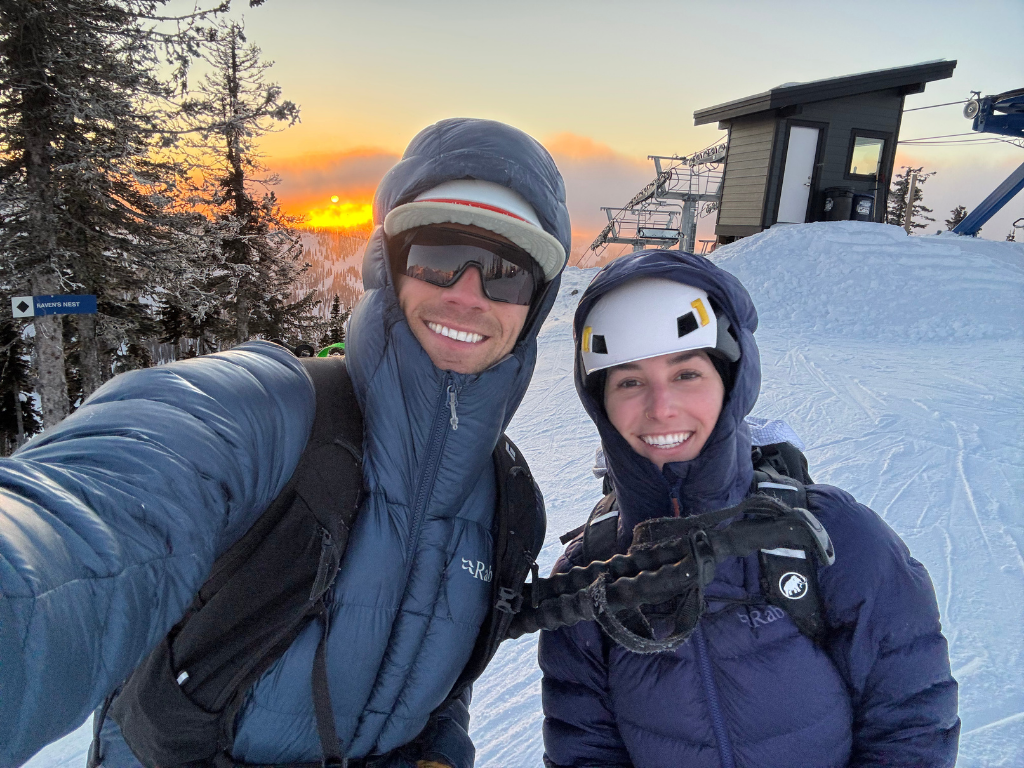
From the gun, the effort was full-on. Running uphill on skis is not something most people practice regularly. Wearing powder touring skis, neither of us stood much of a chance against Canadian SkiMo Team athletes on 64-millimeter race skis, but that wasn’t the point.
Heart rate data from Mikey’s climb shows a near-continuous effort at the upper end of intensity, averaging around 168 bpm and peaking at 175 bpm with very little relief. After more than 30 minutes of sustained Zone 4 and Zone 5 work, we crossed the finish line just in time to catch a classic Kootenay sunset.
Mikey finished first in the Male Adult (19–49) Recreational division with a time of 31:58. Emily finished first in the Female Adult (19–49) Recreational division with a time of 39:24.1
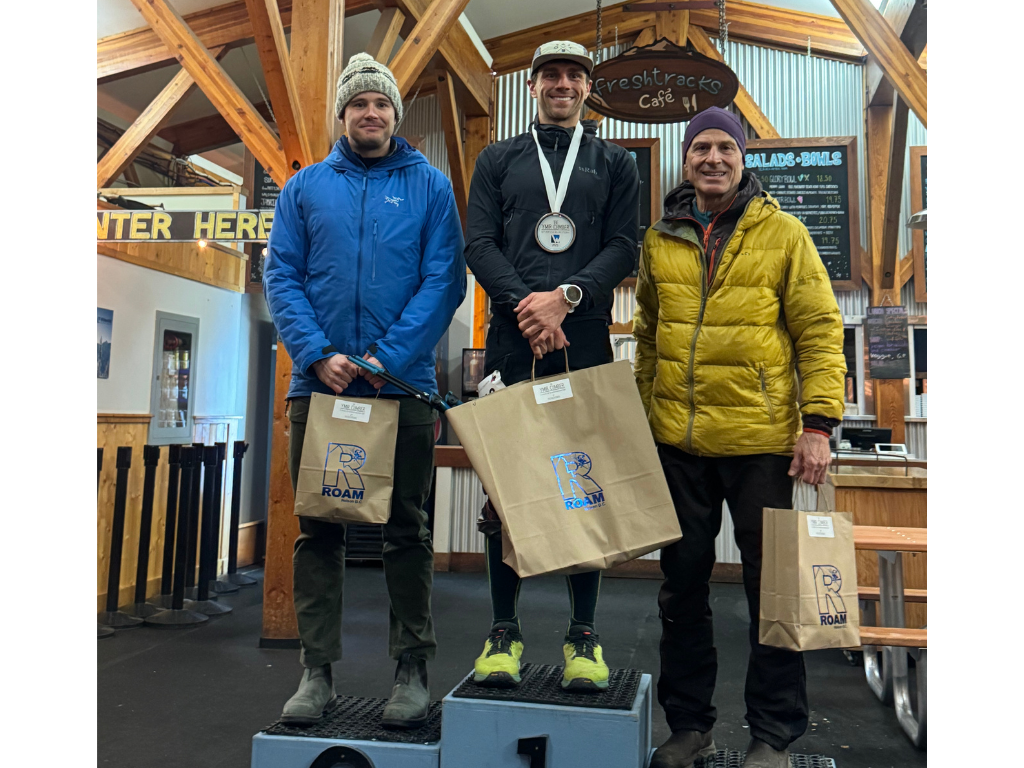
Mikey on the podium
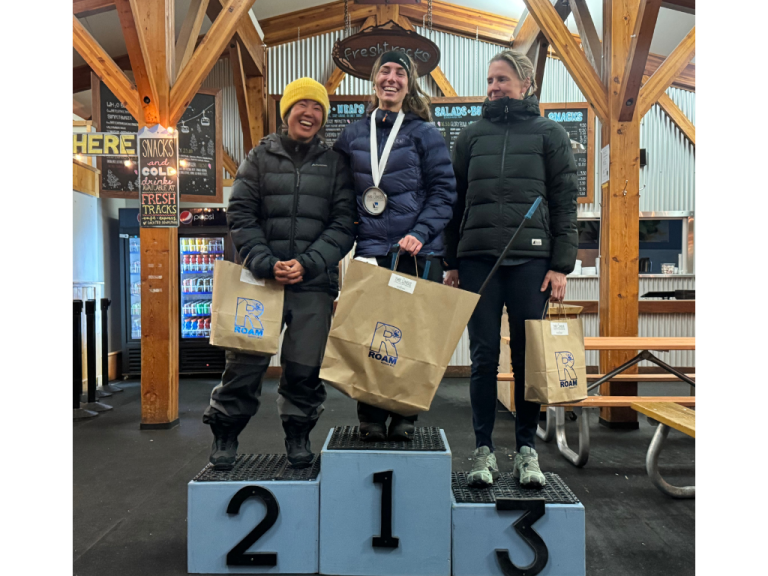
Emily on the podium
With the Individual Race starting early the next morning, recovery mattered immediately. We refueled with French fries and LMNT electrolytes before heading home for vegan mac and cheese with chickpeas. The goal was simple: carbohydrate-rich food that was easy on the gut, replenishing glycogen and setting ourselves up for quality sleep.
Showing up again on fatigued legs is part of what makes multi-day events valuable, not just physically, but mentally.
Individual Race
The Individual Race raised the stakes.
The recreational course covered roughly 9.44 kilometers with about 964 meters of elevation gain and loss. It included multiple ascents and descents, approximately six transitions, two boot packs, and a mix of groomed and backcountry skiing.
Temperatures hovered around 0°F (–18°C) at the day lodge, making it the coldest weekend of the winter so far. Cold snow, firm conditions, and technical transitions demanded focus and efficiency from the start.
The race followed the same initial climb as the Vertical Race before transitioning to an exposed 300-meter boot pack up a feature known as Half Dome. From there, racers dropped into a steep backcountry descent down Goat Slide before rejoining in-bounds groomers. Managing thermoregulation became critical. Climbing in only a base layer kept us from overheating, but made the descents bone-chilling in the frozen alpine terrain.
One final long skin and another boot pack led into a fast descent down a blue groomed run, finishing with an uphill skate behind the day lodge.
By a narrow margin of 60 seconds, Mikey finished first overall in the Recreational Individual Race.
Emily opted not to race the Individual event, choosing instead to focus on technical skiing and controlled boundary-pushing within her current comfort zone. At 18 months post-ACL reconstruction, she continues to rebuild deliberately, and backcountry race formats don’t currently pencil out in that equation.
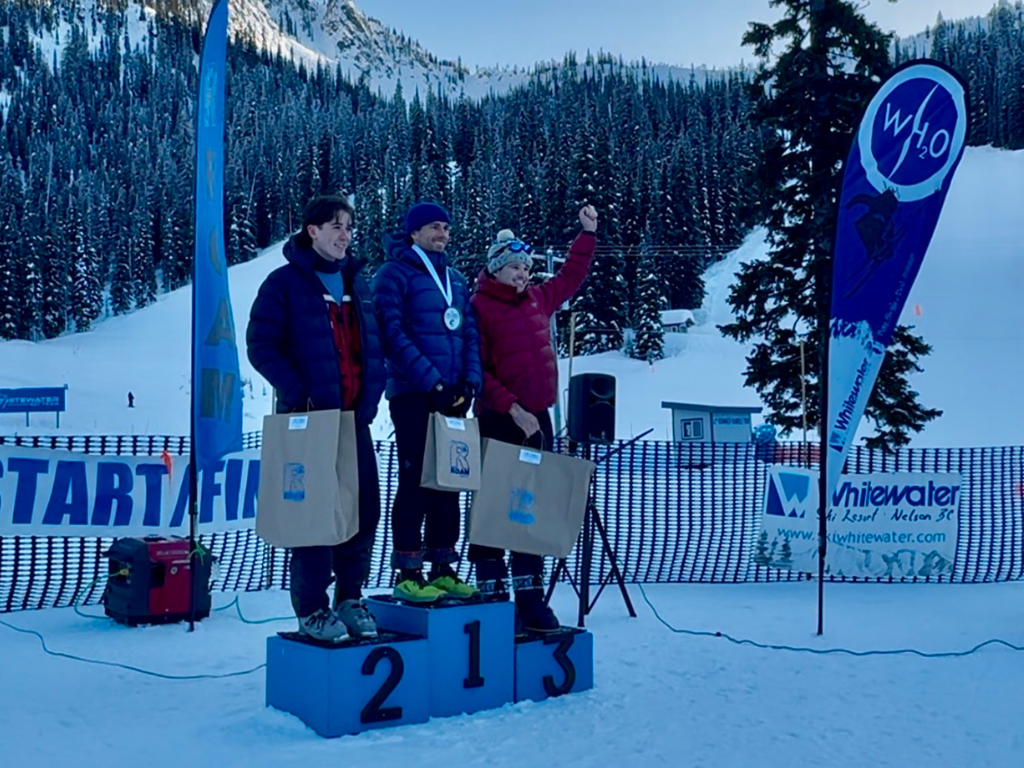
Mikey on the podium for the Individiaul Race
Why we Show Up For Events Like this
We don’t identify as skimo racers, and racing isn’t a core pillar of our training philosophy.
But events like the Ymir Climber offer something valuable. They remind you why you get out of bed at 5 a.m. to fit in uphill work before the day begins. They sharpen attention to nutrition, fueling, sleep, and recovery. And most importantly, they get you outside recreating when you otherwise might not.
Training doesn’t need a podium to be meaningful. But occasionally stepping onto a start line provides clarity about pacing, durability, preparation, and where adjustments are needed.
Sharing the course with elite athletes, recreational skiers, and national team members reinforces what we see every season. Good training principles scale across goals, backgrounds, and ability levels.
That’s what makes weekends like this worth showing up for.
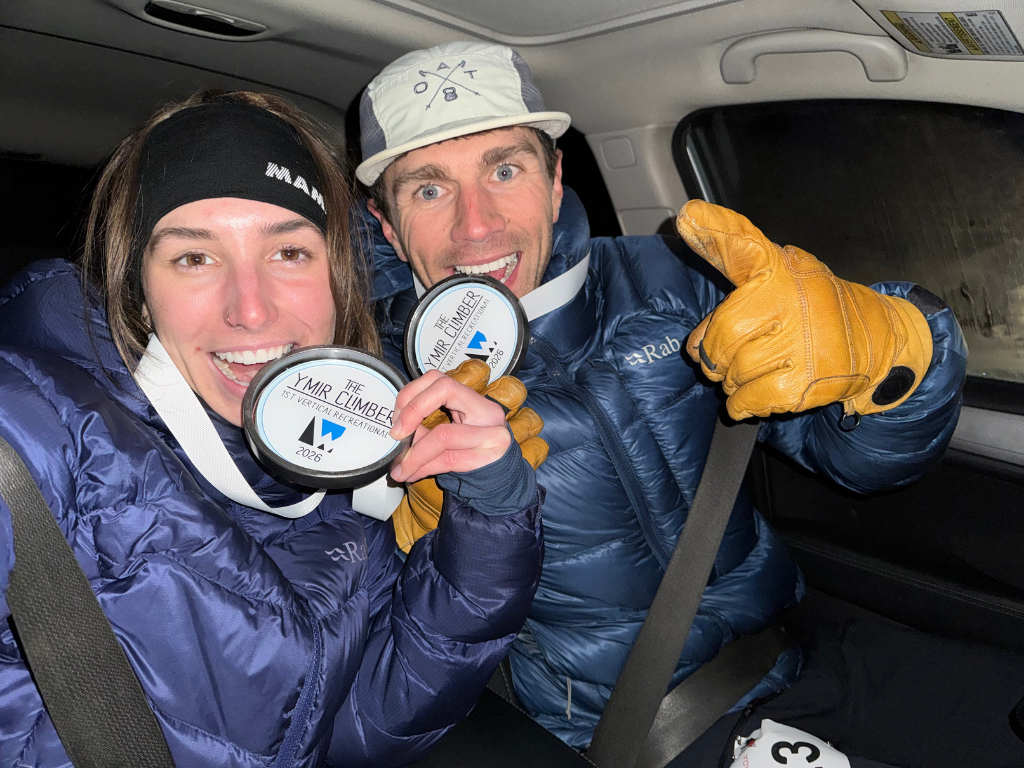
Showing off our heavy metal medals.
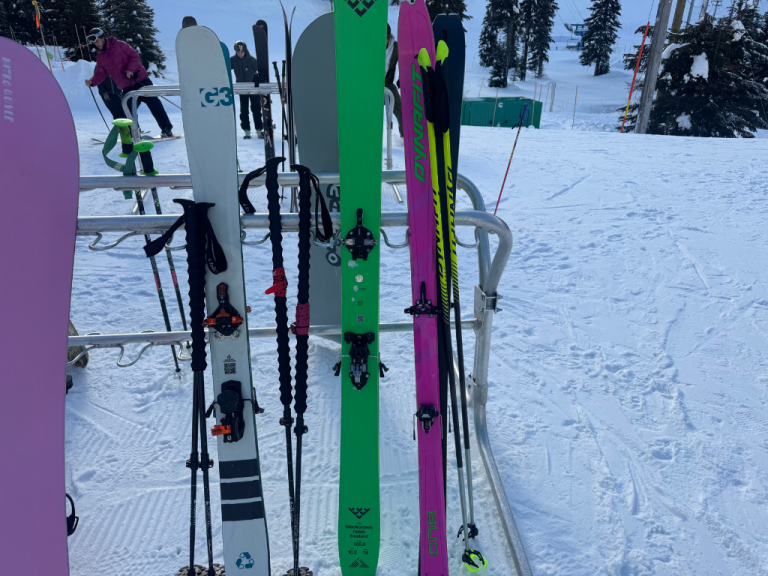
Size DOES matter when it comes to SkiMo races!