Heart Rate Zone Training for Hikers
All five zones, the formula your watch is getting wrong, and how to train them.
Zone two training has blown up. Every watch app and podcast is telling you it's the secret to building endurance, and they're not wrong. Zone two is foundational. But if zone two is all you're doing, you're leaving a massive amount of performance on the table. And if you're relying on your watch to tell you what zone two even is, there's a good chance it's lying to you.
In this article we're breaking down all five heart rate training zones, what each one actually does for hikers and outdoor enthusiasts, and the one formula most people have never even heard of that's dramatically more accurate than what your Garmin or Apple Watch is using right now.

Before we break these down, let's make sure we're on the same page about what heart rate zones actually are. Heart rate zones are intensity ranges that correspond to what's happening inside your body relative to how hard you're working. Each zone is a percentage of your maximum heart rate, and each one drives a completely different physiological adaptation.
Now everything you're about to read is based off one very important number: your maximum heart rate. And how we calculate or estimate that number is what most people get wrong. We'll get there in a few minutes. First, let's walk through each zone and what it's all about.
The Five Heart Rate Zones
-
1
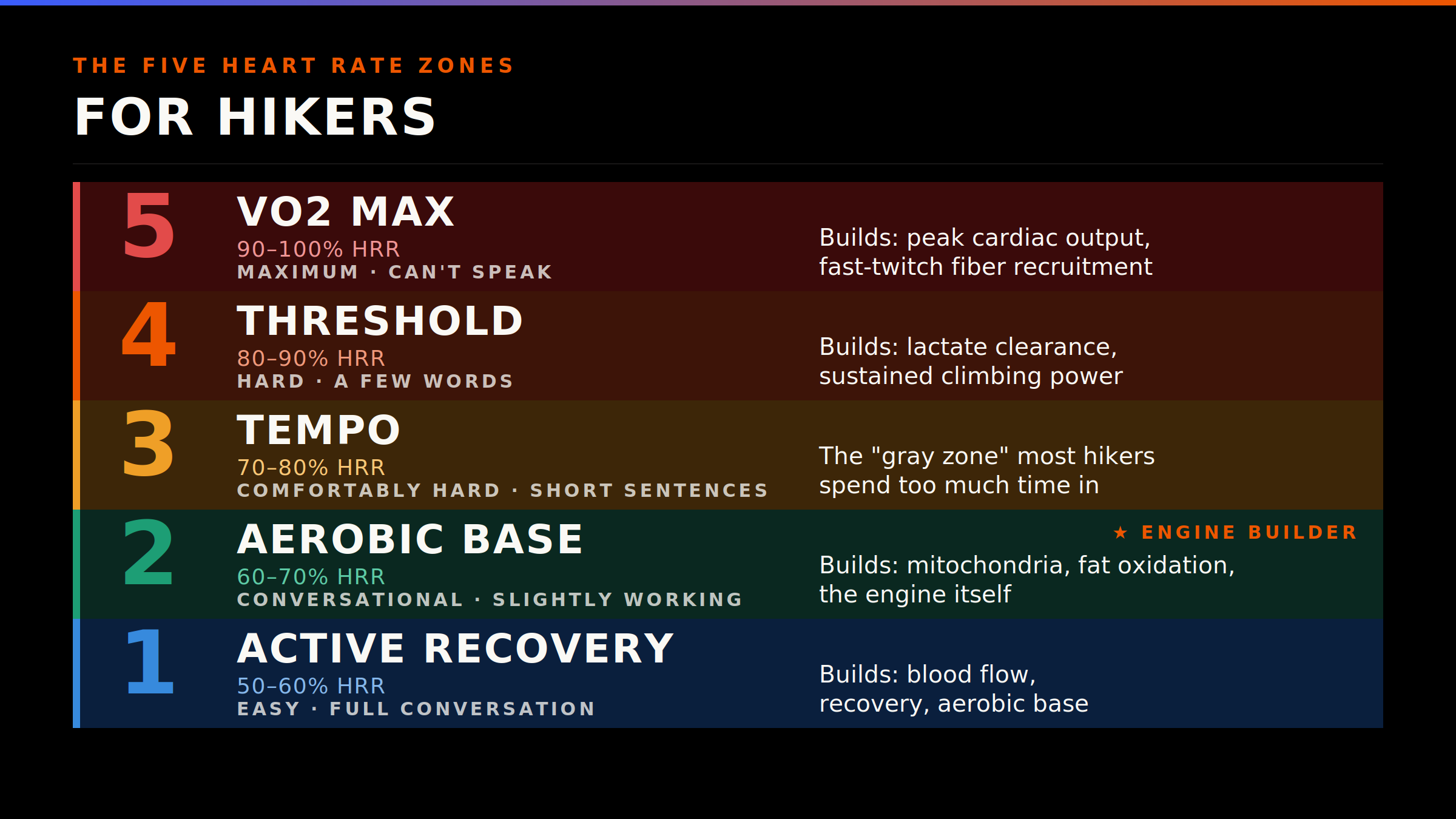
Zone 1 / Active Recovery (50–60%) This is your recovery zone. You're moving, but effort is low. Breathing is easy. It feels effortless. A lot of hikers dismiss this zone because they think if it's not hard, it doesn't count. That's a big mistake. Active recovery keeps the blood flowing without adding stress, and it accelerates the clearance of metabolic waste from harder efforts. On long multi-hour or multi-day efforts in the mountains, zone one is where you'll spend most of your time. Think of it as a place to bank hours, recover, and still contribute to aerobic base building.
-
2
Zone 2 / The Engine Builder (60–70%) Now we move on to the real engine building zone. This is a conversational effort. You can still speak, but you might be a little winded between sentences. On the trail it feels like a mellow, sustained uphill walk where you're working but not gasping for air. At this intensity something remarkable happens inside your body. Your mitochondria, the energy producing structures inside your muscle cells, get stressed in exactly the right way to multiply and become more efficient. Your body shifts toward burning fat as a primary fuel source, which matters a lot on big days in the mountains. Zone two builds cardiac muscle and increases capillary density, meaning more oxygen gets delivered to working muscles with every heartbeat. This is why everybody is talking about zone two. It should take up the majority of your total training hours, ideally 70 to 80 percent of total volume.
-
3
Zone 3 / Tempo, the Gray Zone (70–80%) Zone three is where things start to get interesting, and a lot of recreational hikers and athletes accidentally spend way too much time here. We might call zone three a race pace. It's comfortably hard. Your breathing intensifies. You can probably speak in short sentences but definitely not long ones. It feels like really productive training. Here's the catch. Zone three is often referred to as a gray zone, or no man's land, because it's too hard to stimulate the zone two aerobic adaptations but not hard enough to drive the anaerobic adaptations of zone four. Train here every cardio session and you'll deal with chronic fatigue, never fully recovering between sessions, and never reap the high end benefits of true interval work. That said, zone three does have a place. It mimics a sustained steep climb or a pushed pace on a time sensitive objective. Building tolerance here matters for long approaches and race day efforts. A small amount of zone three is exactly what you want.
-
4
Zone 4 / Lactate Threshold (80–90%) Zone four is where things get spicy. Your body produces lactate faster than it can clear it. Talking is reduced to just a few words. You can sustain it for two to ten minutes, maybe more if you're fit, before you'll likely need to back off. For hikers and outdoor enthusiasts, especially as we age, this is really valuable training. The higher your lactate threshold, the harder you can work before lactate accumulates to the point where you have to back off or stop. Every person who's ever redlined on a summit push and had to stop every twenty feet knows exactly what it feels like when your lactate threshold is too low. Zone four is best trained in intervals: two to four minutes of hard work, equal or slightly longer recovery, repeated for ten to thirty minutes of total work time. One huge caveat. Zone four sessions have real cost. Your nervous system and musculoskeletal system need time to recover. For most people, one hard zone four session every five to ten days is plenty.
-
5
Zone 5 / VO2 Max (90–100%) Zone five is a maximum effort. You cannot talk. You can only sustain it for 30 seconds to maybe two minutes, and it does not feel comfortable. Honest truth: it is not for everyone. For most hikers and recreational athletes, you can get all of your cardiovascular needs met working in zones one through four. Zone five does add something the other zones can't replicate, peak cardiac output and fast twitch muscle fiber recruitment. That has real value, especially for fighting age related decline. But working in zone five assumes you have a solid base to build on. If your joints, ligaments, and tendons aren't ready to handle the load, zone five isn't going to fix anything. It's only going to make things worse. If you're fit, healthy, and have a solid base, touching zone five every now and again is really valuable. If nothing else, it builds the grit muscle.
The Formula Most People Have Never Heard Of
Now the piece that changes everything. How to calculate or estimate your true maximum heart rate.
True maximum heart rate testing is brutal. It requires pushing yourself to genuine failure under controlled conditions, and it comes with a real session cost. Most people aren't going to do it, and honestly, most people shouldn't. So instead, we use submaximal testing and standardized calculations to estimate what your heart rate maximum might be. This matters a lot, because if your heart rate maximum is wrong, every zone is wrong and your training will suffer.
So how does your fancy watch figure out your max? For most people, it's using a very simple equation: 220 minus your age. This equation has been around since the 1970s, and the problem is that the formula has a standard error of plus or minus twelve beats per minute, and it gets dramatically worse as you get older.
Research from Norway's HUNT Fitness Study, which measured actual maximum heart rates in over 3,000 adults, found that 220 minus age can miss the real number by up to 40 beats per minute, especially in older demographics. Forty beats per minute is no small rounding error. That's going to put you in an entirely different zone for every training session.
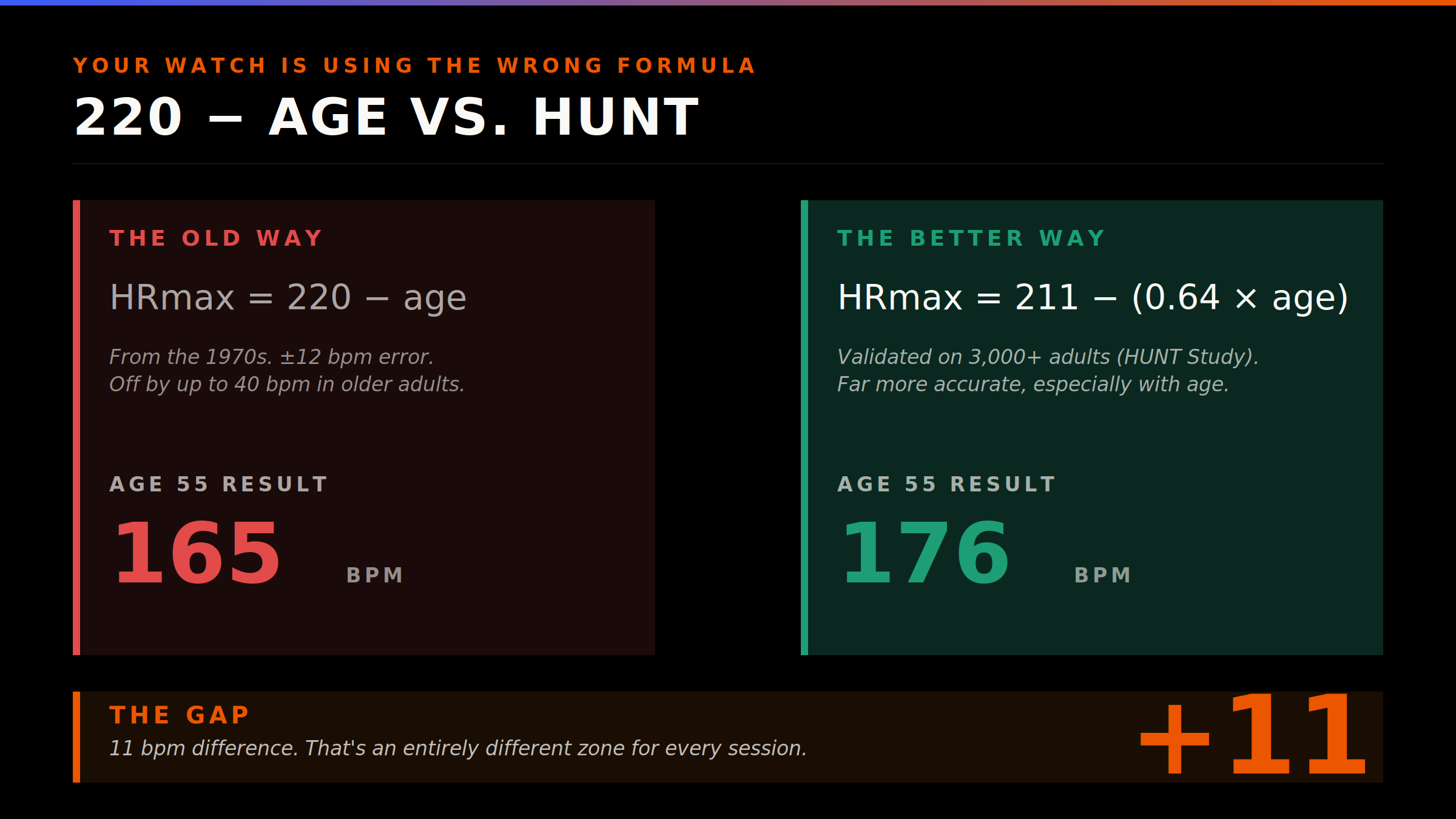
So a 55 year old gets a maximum heart rate of 176, not the 165 from the 220 minus age formula. That's an 11 beats per minute difference, which would put your zone two ceiling 11 beats higher than what your watch might be telling you.
Once you have your heart rate max dialed in, we can use the Karvonen method, also called heart rate reserve, to personalize your zones. This factors in both your max heart rate and your resting heart rate, so the zones reflect your actual cardiovascular fitness.
Calculate Your Zones
We've built a calculator that does all of this for you using the HUNT formula and the Karvonen method. Plug in your age and your resting heart rate. Get all five zones in seconds.
Heart Rate Zone Calculator
Enter your age and resting heart rate to calculate personalized training zones using the Karvonen method, also known as Heart Rate Reserve. We use the HUNT-validated formula (211 − 0.64 × age) instead of the outdated 220 − age formula your watch likely uses.
The Complete Heart Rate Zone Training Guide
A printable guide that breaks down each zone, walks you through the HUNT and Karvonen calculations step by step, and includes three sample workouts you can run this week. Built for hikers, backpackers, and mountaineers.
Your Watch Is Probably Lying to You
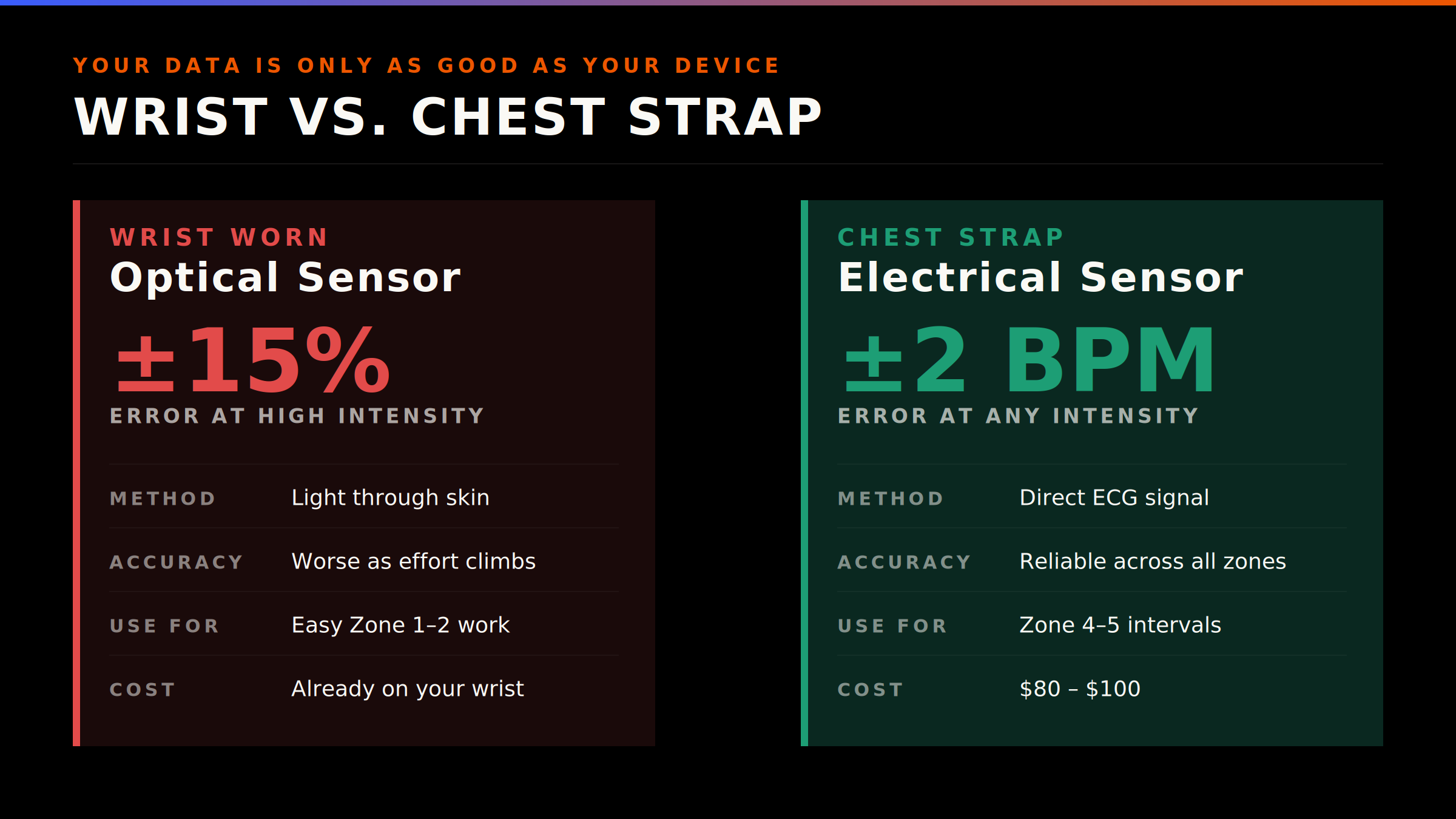
Even with the right formula and the right heart rate zones, your data is only as good as the device you're measuring with. The truth is, wrist based monitors are not very accurate. Research shows they can be off by 10 to 15 percent, and they get worse as intensity climbs. Exactly when you need them the most.
If you're serious about utilizing heart rate zone training, invest in a chest strap monitor. They measure the electrical activity of your heart directly, the same way an ECG does, and they're accurate within one to two beats. They're not cheap. You're looking at 80 to 100 dollars for a good one. But if you're invested in your training, they're worth their weight in gold.
Programming It Into Your Training
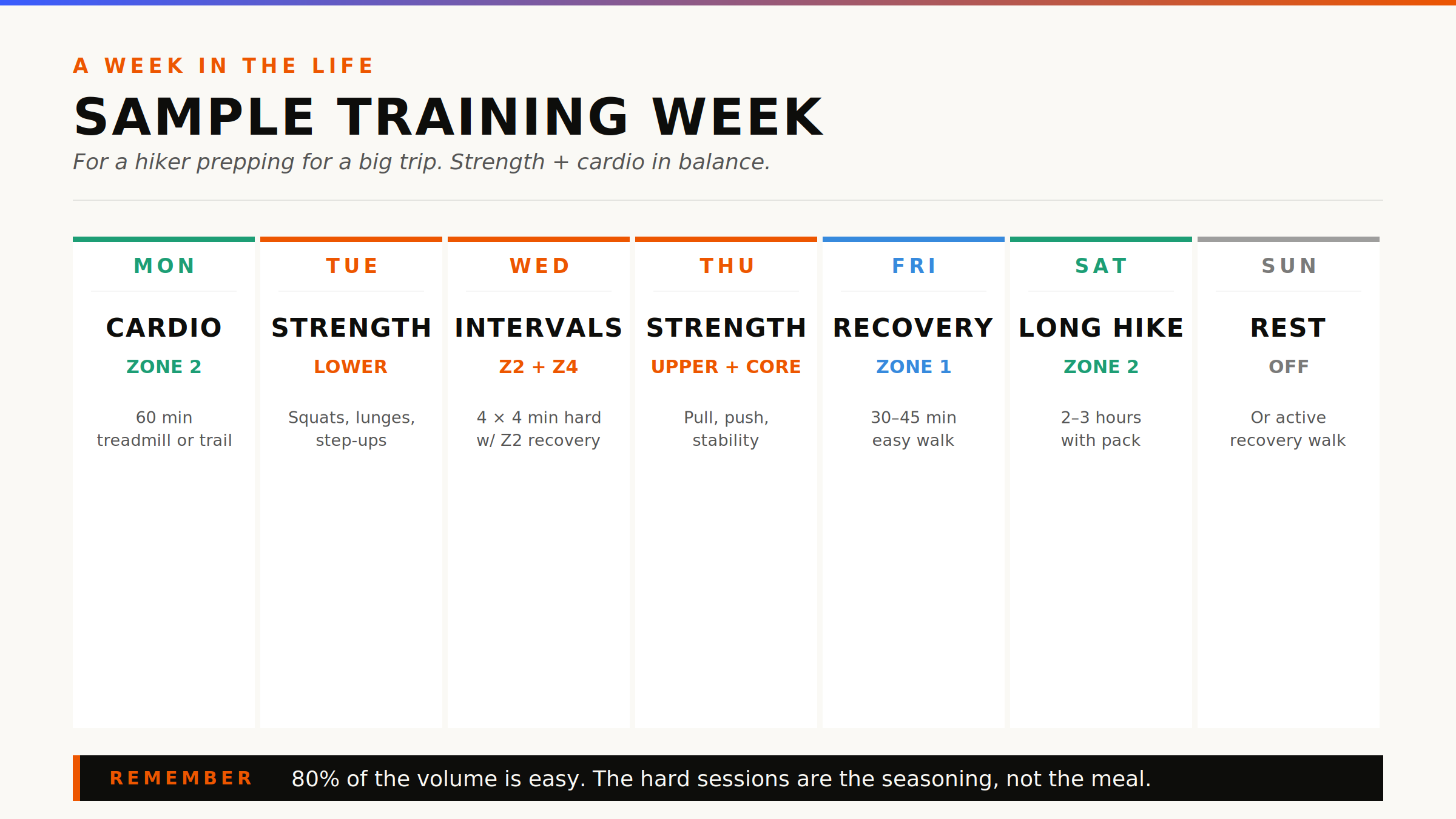
So how do you fit all of this into your training plan? Most of our programs include two to three dedicated cardio sessions per week, layered between strength training sessions. That's plenty to see adaptations in both domains.
The real key is to slowly layer in your cardio in the same periodized fashion you do with strength and stability training. You don't start by maxing out on deadlifts, so you probably shouldn't start with zone four hill sprints either. Start easy. Log hours in zone one and zone two. Build your aerobic base. Let your tendons and joints catch up to the increased work demand. After eight to twelve weeks, once your aerobic base is well developed, start layering in more meaningful zone three and zone four work.
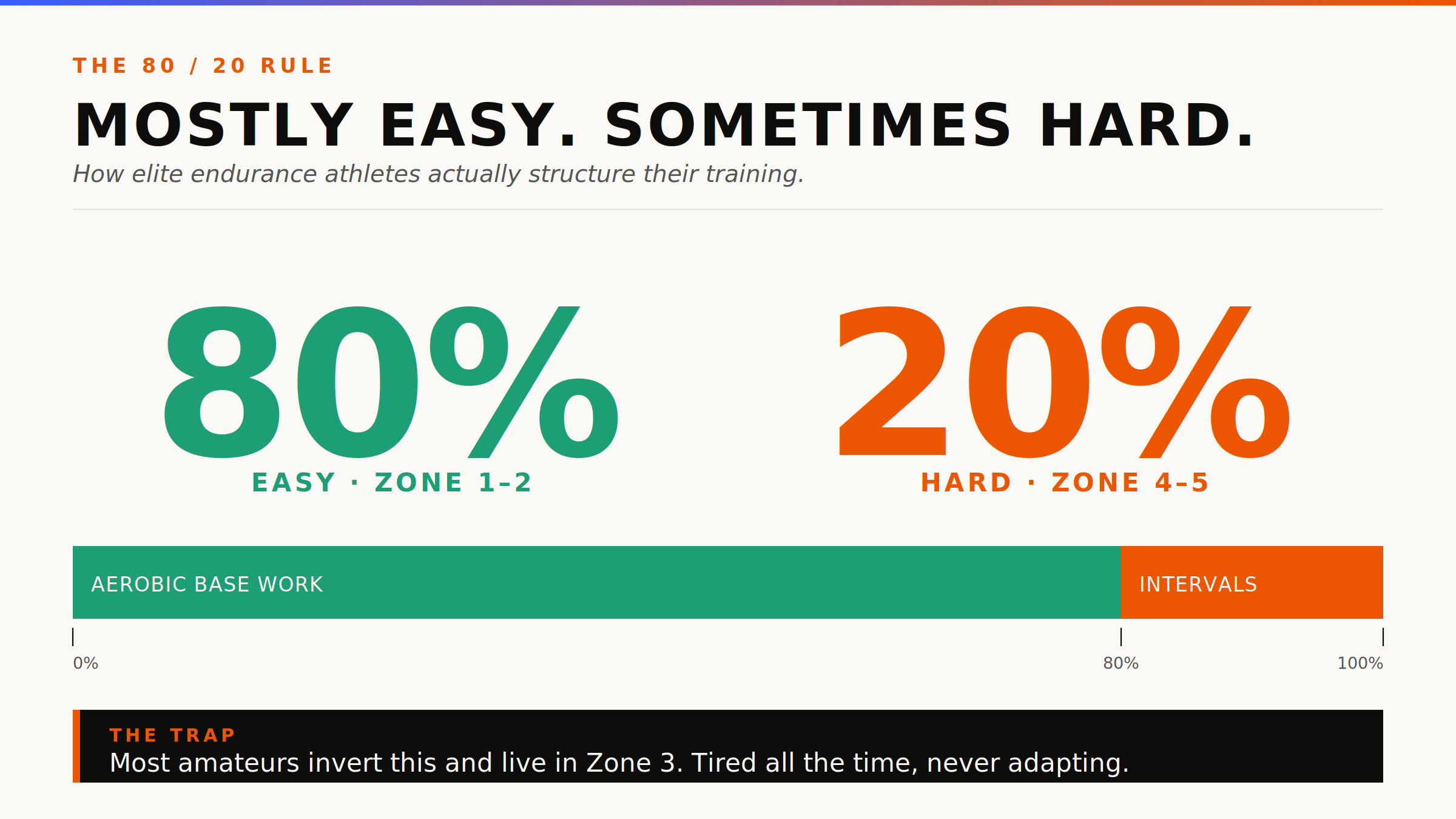
The biggest mistake we see people make is trying to do everything at once. Build your chassis first. Then start building your engine. Then improve your upper threshold capacity. That is the order that drives long term success.

Train With OAT
Heart rate zone training can feel complicated because honestly, it is. There's a lot to learn, a lot of variables involved, and a ton of misinformation out there. Once you understand the zones and know how to calculate them accurately, it becomes an invaluable tool to level up your time outside.
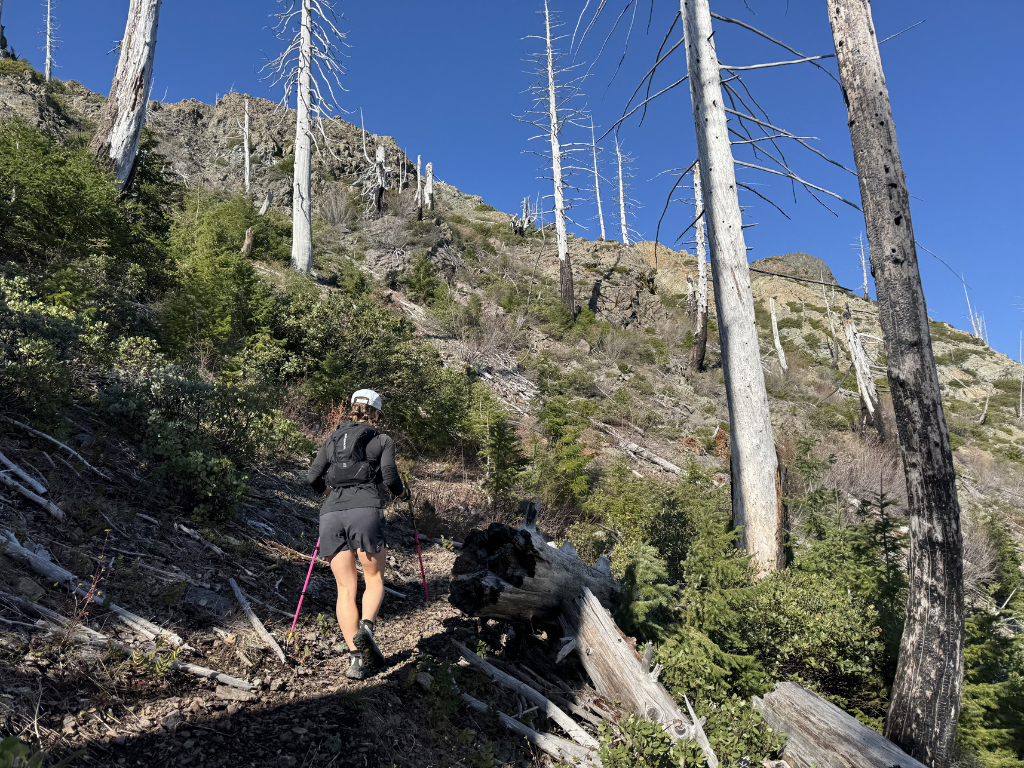
If you want all of this periodized for you, built around real trail demands and designed for hikers, backpackers, and mountaineers, we have programs built just for you. Start with a seven day free trial.
Thanks for reading. If you have questions, leave them in the comments, send us a message, or check out the rest of the site. See you on the trail.